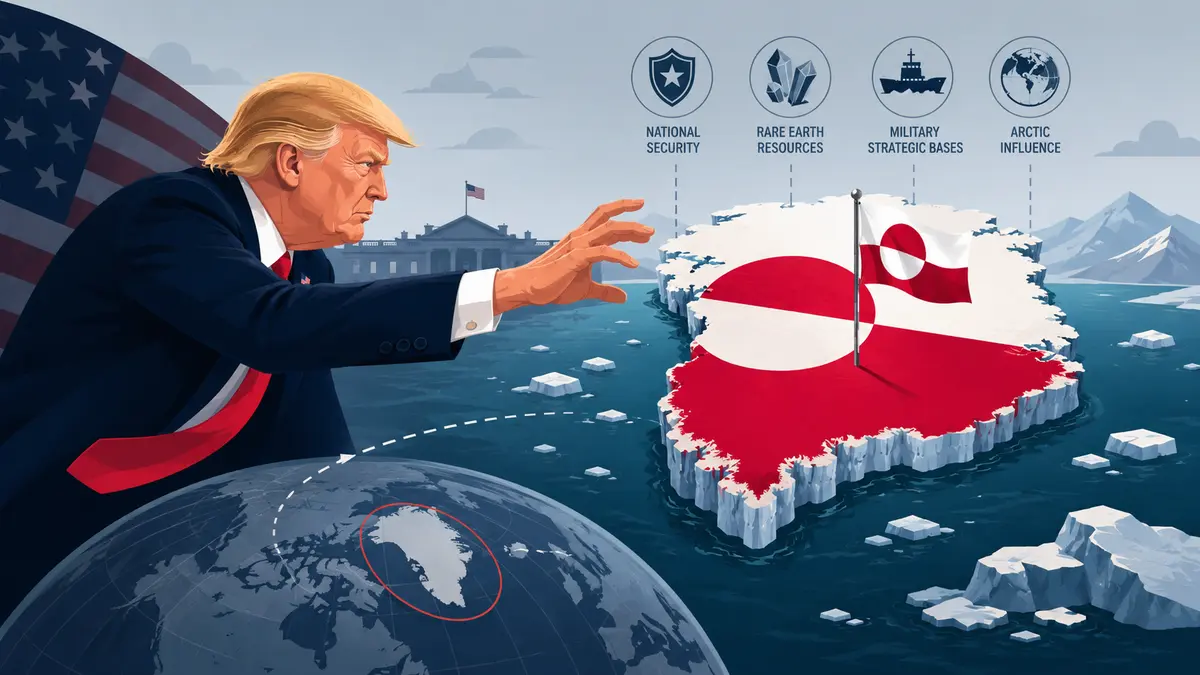
Trump’s interest in Greenland has sparked a diplomatic standoff involving Denmark, NATO, and the European Union. Here’s what’s really driving the push to control the Arctic’s biggest island.
Imagine a country the size of a small continent, home to fewer people than a single American college town, suddenly becoming the center of a global power struggle. That’s Greenland today. President Trump wants it, Denmark refuses to sell it, and the rest of the world is watching closely, because whoever holds Greenland may end up holding the keys to the Arctic’s future.
To understand why an ice-covered island most people couldn’t find on a map has become this important, it helps to start with what Greenland actually is, before getting into who wants it and why.
A Small Island With a Big Story
Greenland is the world’s largest island, sitting in the Arctic between North America and Europe. Despite its massive size, roughly three times the size of Texas, only about 57,000 people call it home, most of them clustered along the ice-free southwestern coast near the capital, Nuuk.
About 80 percent of Greenland lies buried under a thick ice sheet, leaving little room for farming or large-scale industry. The territory’s GDP (gross domestic product, meaning the total value of everything it produces in a year) sits at a modest $3.3 to $3.5 billion, smaller than the annual revenue of many mid-sized American companies.
Fishing dominates the economy, making up about 90 percent of Greenland’s exports, according to this detailed profile of Greenland’s economy. Tourism is growing too, though it remains a small piece of the picture. Because the local economy can’t cover its own needs, Greenland leans heavily on subsidies from Denmark, and it doesn’t maintain its own military.
On paper, none of this screams “global prize.” So what exactly makes Greenland worth fighting over? Two things: what’s hidden underground, and where it happens to sit on the map.
Buried Riches Waiting for a Warmer World
Beneath Greenland’s ice lie substantial deposits of gold, diamonds, iron ore, and zinc. It also holds some of the largest known reserves of rare earth elements, a group of minerals essential for building smartphones, electric vehicle batteries, and advanced defense technology. Altogether, experts estimate these untapped resources at around $5 trillion.
That number alone explains a lot of the recent attention, but it raises an obvious question. These deposits have existed for millions of years, so why is everyone suddenly interested now? The answer is global warming. As Arctic ice melts, terrain that was once impossible to mine or drill is slowly becoming accessible, turning Greenland into one of the most talked about long-term investments on the planet.
A Front-Row Seat to the Arctic
Greenland’s location matters just as much as what’s underground. Sitting between North America and the Arctic, the island is ideally placed for early warning systems that can detect missile launches, and for monitoring military and commercial vessels moving through the region, a fact not lost on the United States.
Melting Arctic ice is also opening entirely new shipping routes across the top of the world. Ships sailing from Asia to Europe through these routes could shave weeks off their journey compared to traditional paths like the Suez Canal. Greenland sits almost directly at the exit point of these emerging lanes, making it a natural gatekeeper for future Arctic trade.
Greenland and Denmark: It’s Complicated
Greenland isn’t fully independent. It belongs to the Kingdom of Denmark, though it runs most of its own affairs. Denmark sends Greenland roughly $605 million a year in subsidies, and around half of Greenland’s government revenue comes directly from Copenhagen.
Under a “Self-Rule Act,” Denmark handed Greenland’s parliament control over schools, healthcare, taxation, and mining laws. Denmark still manages defense, foreign policy, and currency on Greenland’s behalf. In practice, this makes Greenland part of Denmark, and by extension, part of both the European Union (EU) and NATO, the military alliance built around mutual defense among the US, Canada, and European nations.
How China’s Ambitions Set the Stage
The current standoff didn’t start with Trump. Back in 2018, China declared itself a “Near-Arctic State,” a label with no real geographic basis but one meant to justify a claim to the region’s future. Around the same time, Chinese companies attempted to buy a naval base in Greenland and fund airport construction projects there.
That move alarmed both the US and NATO. Denmark, keen to keep its Western allies happy, stepped in and blocked the Chinese investments. China already dominates the global rare earth minerals trade, and Western nations have been actively looking for ways to loosen that grip, which is part of what made Greenland’s resources so appealing as an alternative source.
This pattern, a global power circling a resource-rich territory for both economic and strategic reasons, isn’t unique to Greenland. A similar dynamic has played out around Taiwan, as explored in this piece on what a Chinese takeover of Taiwan could mean for the global economy. Once China moved on Greenland, it wasn’t long before Trump followed with his own ambitions.
Trump’s Push to Acquire Greenland
Trump has publicly said he wants “immediate negotiations” to acquire Greenland, citing national security, while insisting he “won’t use force” to get it. Greenland’s leaders and Denmark, a NATO member, have both rejected his demands outright.
The disagreement escalated into a broader diplomatic dispute, with Trump initially threatening additional trade tariffs against several European allies who opposed the plan. At the World Economic Forum in Davos, Switzerland, Trump later said he had dropped those tariff threats after reaching “the framework of a future deal” following talks with NATO Secretary General Mark Rutte.
This isn’t Trump’s first attempt. He made a similar offer to buy Greenland back in 2019, during his first term, only to be told it wasn’t for sale. Though he has never named an exact figure, internal estimates from White House planning circles and financial analysts place the potential purchase value at up to $700 billion.
Trump revived the idea shortly after returning to office in January 2025. Two months later, Vice President JD Vance visited Greenland and criticized Denmark for what he called insufficient investment in the territory’s protection.
Resources or Realpolitik? Reading Between the Lines
Trump has pointed to natural resources as a motivating factor in other dealings, including with Ukraine, though he denies that resources are the main reason behind his Greenland ambitions. The numbers actually back him up on this one.
Paying up to $700 billion to access resources worth an estimated $5 trillion might sound like a bargain, but extracting, processing, and transporting those resources from one of the harshest environments on Earth would eat deeply into that value. As a pure business deal, it’s a shaky one. That makes the more likely explanation geopolitical: a play for military positioning and long-term US national security rather than a simple resource grab.
Pushback From Denmark, the EU, and NATO
Greenland has no military of its own and isn’t a NATO member in its own right, though it falls under the alliance’s protection through Denmark. When Trump threatened further tariffs, Danish Prime Minister Mette Frederiksen fired back, declaring that “Europe won’t be blackmailed.”
She and other European leaders followed with a joint statement warning that Trump’s approach could “undermine transatlantic relations and risk a dangerous downward spiral.” Across Europe, leaders have repeatedly stressed that only Denmark and Greenland have the authority to decide the island’s future.
Public opinion in Greenland tells a similar story. Most Greenlanders oppose the idea of the US taking control, and many already resent the degree of influence Denmark holds over their affairs. Being handed from one distant capital to another isn’t exactly the independence they’ve been hoping for.
The Bigger Picture
Greenland’s story is really a preview of what the next few decades of global politics might look like. As the Arctic thaws, the resources and shipping routes it reveals will keep drawing attention from major powers, and small territories with outsized strategic value will keep finding themselves at the center of disputes they never asked to be part of.
Whether Trump’s push eventually leads to a deal, a stalemate, or something else entirely, one thing is already clear. Greenland’s ice may be melting, but the diplomatic tension around it is only heating up.
What do you think should happen to Greenland’s future? Share your thoughts in the comments below.