Ten out of every 100 Indonesians live in poverty. Scale that up across a nation of nearly 280 million people, and you get roughly 25 million people, almost the entire population of Australia, getting by on very little. Meanwhile, just four men in Indonesia own more combined wealth than the poorest 100 million citizens put together.
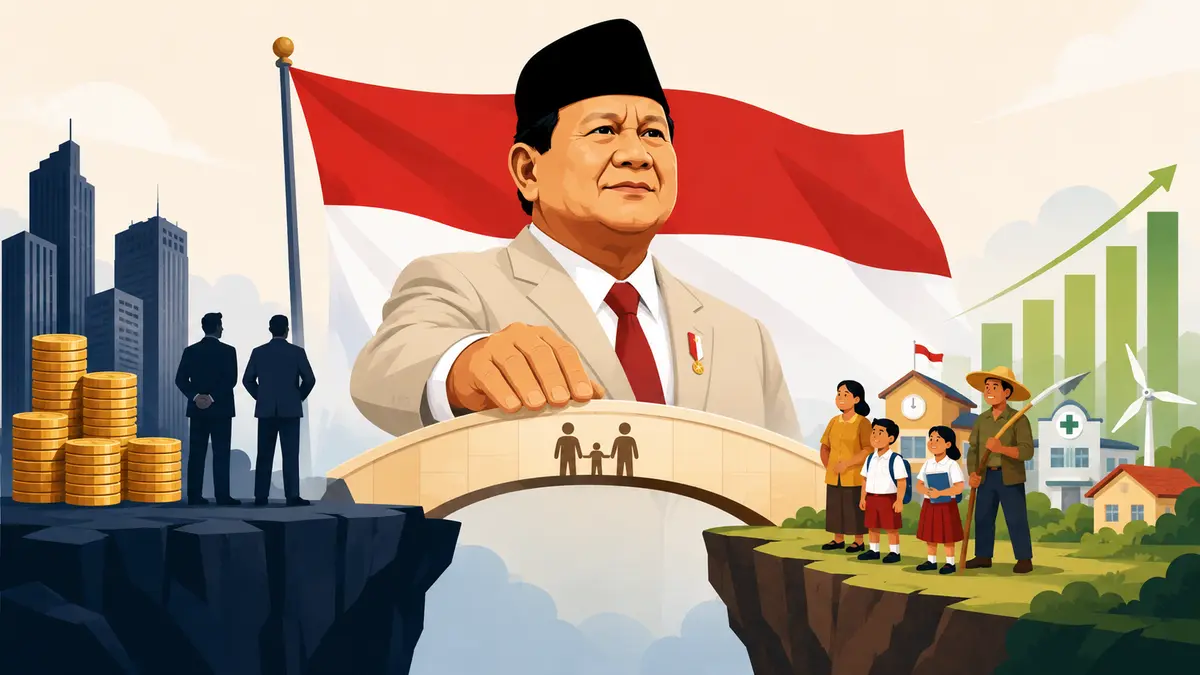
That gap is the backdrop against which President Prabowo Subianto is trying to rewrite his country’s economic story. Since taking office, he has rolled out an unusually assertive mix of welfare programs, asset seizures, and state-controlled investment vehicles, all aimed at narrowing the distance between Indonesia’s ultra-rich and everyone else. Some of it appears to be working. Some of it has rattled global markets and triggered the largest student protests Indonesia has seen since the fall of Suharto in 1998.
So the question worth asking is simple: can Prabowo Subianto actually shrink wealth inequality in Indonesia, or is he trading one crisis for another?
Indonesia’s Wealth Gap Problem: A Nation of Extremes
Indonesia’s economy has grown steadily for years, but that growth has not been shared evenly. The richest 1% of the population now holds nearly half of the country’s total wealth, while the middle class, historically the engine of Indonesia’s consumer economy, has been quietly shrinking.
It helps to separate two ideas here. Income inequality measures how unevenly people’s yearly earnings are spread across a population. Wealth inequality goes further, capturing everything a person owns, including property, savings, and business assets, not just what they earn in a given year. Indonesia scores badly on both counts, currently ranking as the sixth most unequal country in the world by income distribution.
The numbers behind that ranking are stark. Indonesia’s four richest billionaires, Prajogo Pangestu, Low Tuck Kwong, Robert Budi Hartono, and Michael Bambang Hartono, collectively hold more assets than the 100 million poorest Indonesians combined. That is not a rounding error. It is a structural imbalance that has built up over decades of uneven growth.
For readers who want a wider lens on how this kind of gap forms in economies tied into global trade and capital flows, this piece on wealth inequality, globalization, and capitalism offers useful context on the forces at play beyond Indonesia’s borders.
Against that backdrop, Prabowo Subianto came into office promising something different: a more muscular, state-driven push to redirect wealth back toward ordinary Indonesians.
Prabowonomics: What Prabowo Subianto Is Actually Doing
Commentators have started calling Prabowo’s approach “Prabowonomics,” a blend of assertive state-led capitalism (an economic model where the government actively directs strategic industries and investment, rather than leaving those decisions purely to private markets) and large-scale populist welfare spending.
Taking control of state resources. Prabowo has gone after wealthy oligarchs and industrialists directly, particularly in the mining and palm oil sectors. His government has seized millions of hectares of illegal palm oil plantations and shut down unlicensed mining operations, arguing that these assets were never legitimately private in the first place.
He also created the Danantara Sovereign Wealth Fund, a sovereign wealth fund being a state-owned investment vehicle that pools national assets or resource revenue to fund long-term development. Danantara consolidates Indonesia’s state-owned enterprises under one roof and channels capital into rural cooperatives and strategic industries. Alongside this sits a policy of resource nationalism, meaning Prabowo’s government insists that revenue from Indonesia’s natural resources stays within the country rather than flowing out to foreign or private interests.
Welfare programs aimed at the grassroots. The flagship Free Nutritious Meals Program delivers food to tens of millions of students and expectant mothers, designed to fight childhood stunting while also pumping money into local economies through food procurement. Alongside it, the Koperasi Merah Putih, or Red and White Cooperatives, give rural communities direct institutional access to capital, an attempt to decentralize economic power away from Jakarta’s elite. The government has also introduced Sekolah Rakyat (People’s Schools) and free health checkups in schools to cover basic needs at the community level.
Cracking down on elite privilege. Prabowo’s administration has targeted tax evasion among large corporations and wealthy individuals. When nationwide protests erupted over inequality and the rising cost of living, he responded by scrapping controversial housing allowances for members of parliament and suspending their overseas trips, a symbolic but pointed gesture toward accountability.
The Good: Where Prabowo Subianto’s Policies Are Working
Some of these Indonesian president’s reforms have delivered real, measurable results.
The crackdown on corporate corruption has been unusually aggressive by regional standards. The government confiscated 4 million hectares of illegal plantations and mines and revoked the licenses of 28 corporations, effectively clawing back resources that had been operating outside the law for years.
The Free Nutritious Meals program rolled out nationwide, reaching millions of students and low-income families with direct nutritional and economic support. Early governance under Prabowo also leaned heavily on merit, and his administration’s first 100 days succeeded in drawing skilled Indonesians working abroad back home to take up government roles.
On the international stage, Prabowo has scored genuine wins too. Indonesia joined BRICS, the economic bloc built around Brazil, Russia, India, China, and South Africa (now expanded to include other emerging economies), giving Jakarta a louder voice in global economic policy. He also personally negotiated with the United States to cut punishing tariffs, taxes on imported goods, on Indonesian exports from 32% down to 19%, a meaningful win for local industry.
The Bad: Market Chaos and Democratic Strain
The costs of this approach have been just as visible as the wins.
Prabowo’s public rhetoric branding billionaires as “thieves” spooked the country’s wealthiest citizens, triggering capital flight, the term for when investors and wealthy individuals move their money out of a country because they have lost confidence in its economic direction. The result pushed Indonesia’s stock market into the worst-performing position of any major market in the world, down more than 40%.
The Indonesian rupiah has not fared much better, losing up to 14% of its value in what analysts describe as a “doom loop,” a self-reinforcing cycle where falling confidence drives further losses, which in turn erodes confidence further. Ratings agency S&P has warned that Indonesia’s sovereign credit rating (a measure of a government’s ability to repay its debts, which directly affects how expensive it is for that government to borrow) could face a downgrade.
Investors have also raised concerns about how much power is now concentrated around the presidency. The Danantara fund reports directly to Prabowo rather than through Indonesia’s Ministry of Finance, a structure that bypasses normal institutional checks and worries those who track governance risk.
To help pay for his welfare promises while tax revenues fell short, Prabowo’s government made deep cuts to higher education funding, slashing scholarships for low-income students and pushing tuition costs higher. That decision helped spark some of the largest student-led protests Jakarta has seen since 1998, when similar unrest helped bring down the Suharto regime.
Perhaps most striking to economists was Prabowo’s decision to dismiss Sri Mulyani Indrawati, Indonesia’s internationally respected finance minister, replacing her with a political ally. Combined with unusual growth targets placed on the central bank, this has raised questions about central bank independence, the principle that a country’s monetary authority should operate free from political pressure in order to maintain stable, credible policy.
Conclusion: Can Prabowo Subianto Really Close the Gap?
Every economic policy comes with trade-offs, and Prabowo Subianto’s reforms are no exception. An economy behaves a bit like a bundle of threads tied together. Pull hard on one thread to fix a problem, and the tension often pulls several others down with it.
Redistributing wealth from the top and funding welfare at scale has produced real, visible gains for millions of ordinary Indonesians. But the same policies that took aim at oligarchs also unsettled the investors and institutions the wider economy depends on, and centralizing so much decision-making around one office raises legitimate questions about accountability, regardless of good intentions.
Whether Prabowonomics ultimately narrows Indonesia’s wealth gap may come down to sequencing and discipline, not ambition. Bold redistribution paired with credible, independent institutions could work. Bold redistribution that hollows out those institutions along the way risks solving one crisis by creating another. The next year or two, as markets, the currency, and public trust either stabilize or don’t, will likely tell us which path Indonesia is actually on.
What do you think, can a state this assertive lift millions out of poverty without breaking the economy that has to pay for it? Share your thoughts in the comments below.