Berkshire Hathaway is going big on Alphabet. Is Google winning the AI race?
Alphabet to raise $80 billion and Berkshire Hathaway turns out to be the biggest investor. See what this means for Berkshire and Google in the AI business.
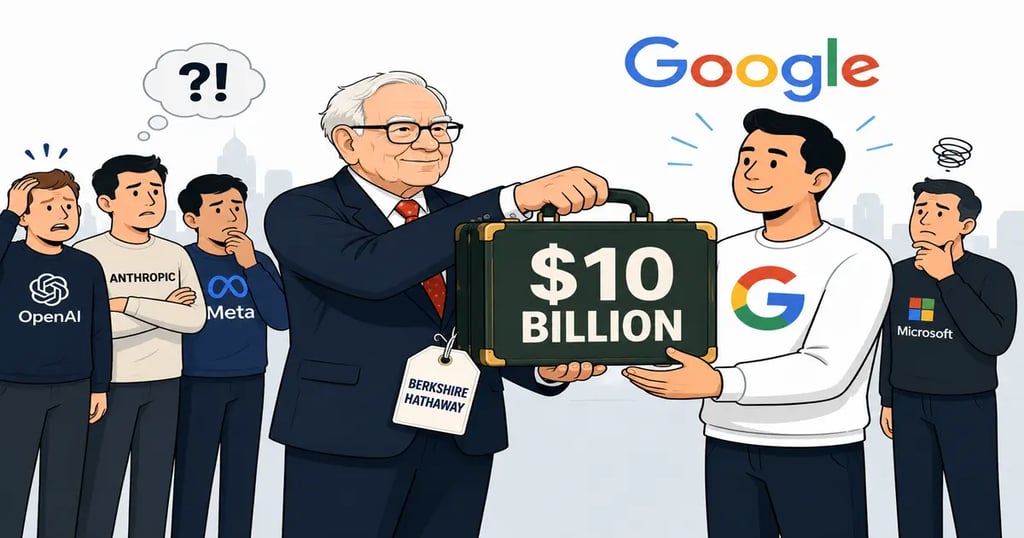
Alphabet, the parent company of Google, planned to raise 80 billion dollars worth of shares, which is the highest amount over the past two decades they have ever raised.
And, surprisingly, Berkshire Hathaway, founded by Warren Buffet, is investing a massive stake of 10 billion dollars, adding to their existing 16.6 billion position.
So, does this mean Google is ahead of this AI race?
At first glance, it might seem strange that Google needs to raise so much money. After all, this is one of the most profitable companies in the world.
But according to the Alphabet, the reason is actually quite simple: demand.
The company says it is experiencing "unprecedented customer demand" for its AI products and services from both businesses and consumers. In fact, demand has reportedly grown so fast that it is starting to exceed the company's available supply.
That's not a problem many companies would complain about.
Think of it like a restaurant that suddenly becomes the most popular place in town. The issue is no longer attracting customers, it's finding enough tables to seat them.
Google appears to be facing a similar situation with AI.
To keep up, the company plans to invest heavily in the infrastructure that powers its AI ecosystem. That means building more computing capacity, expanding data centers, developing custom AI chips, and improving the tools it offers to businesses.
Alphabet has already increased its annual capital spending forecast by another $5 billion, bringing expected spending to between $180 billion and $190 billion.
In short, Google is spending aggressively today because it believes AI demand will be even bigger tomorrow.
Google raising money is interesting.
Berkshire Hathaway increasing its investment may be even more interesting.
For decades, Berkshire has built its reputation by investing in businesses with strong fundamentals and long-term potential. It is not known for blindly chasing trends or jumping into speculative investments.
That's why investors pay close attention whenever Berkshire takes a position in a company.
The latest investment also suggests confidence in Google's AI strategy.
According to analysts, Berkshire CEO Greg Abel appears to believe that Alphabet's massive AI spending will generate reasonable returns over time, even as the company raises additional capital.
That is an important point.
Many investors see billions of dollars in AI spending and worry about costs. Berkshire appears to be looking at the other side of the equation, the potential returns.
With Berkshire increasing its exposure to Alphabet, many see it as a vote of confidence not only in Google but also in the long-term future of AI itself.
Of course, Google is not the only company spending heavily to compete in the AI race.
In fact, almost every major AI company is searching for more capital.
Anthropic recently reached a valuation of $965 billion after raising $65 billion in funding, reportedly making it the world's most valuable startup and even surpassing OpenAI in valuation.
Meanwhile, OpenAI, the company behind ChatGPT, is reportedly preparing for a potential IPO that could give it access to even more funding.
If there is one thing these companies have in common, it is this:
AI is expensive.
Really expensive.
Building advanced AI models requires enormous investments in computing power, infrastructure, research, and talent. As a result, every major player seems to be raising billions of dollars to stay competitive.
The AI race is no longer just a technology race.
It is also a capital race.
This is the question everyone wants answered.
The truth is, it's still too early to know who will ultimately win.
However, Google may have one major advantage that many competitors don't.
Unlike Anthropic and OpenAI, whose businesses are heavily focused on AI, Google already owns several mature and highly profitable businesses. Search, YouTube, Cloud, Android, and digital advertising continue to generate billions of dollars in revenue every year.
That matters because AI is currently a cash-burning industry.
Companies are spending enormous amounts of money simply to remain competitive.
Google, however, can use profits from its existing businesses to fund its AI ambitions. It doesn't have to rely entirely on AI becoming profitable overnight.
And that may be exactly what Berkshire Hathaway likes.
For decades, Berkshire has focused on investments that offer a strong margin of safety. In other words, it prefers businesses that can survive even if things don't go exactly as planned.
Google fits that description remarkably well.
If AI becomes the next great technological revolution, Google stands to benefit significantly.
But even if AI turns out to be less profitable than many expect, Google still owns some of the most successful businesses on the planet.
That doesn't guarantee Google will win the AI race.
But it does mean it may be one of the best-positioned companies to stay in the race for the long haul.
MacroUTC
Newsletter
© 2024. All rights reserved.
Contact