Botswana Diamond Production Decline and Economic Risk
Botswana Diamond Production Decline is raising concerns about economic growth as falling demand and lab-grown diamonds reshape the global market in 2026.
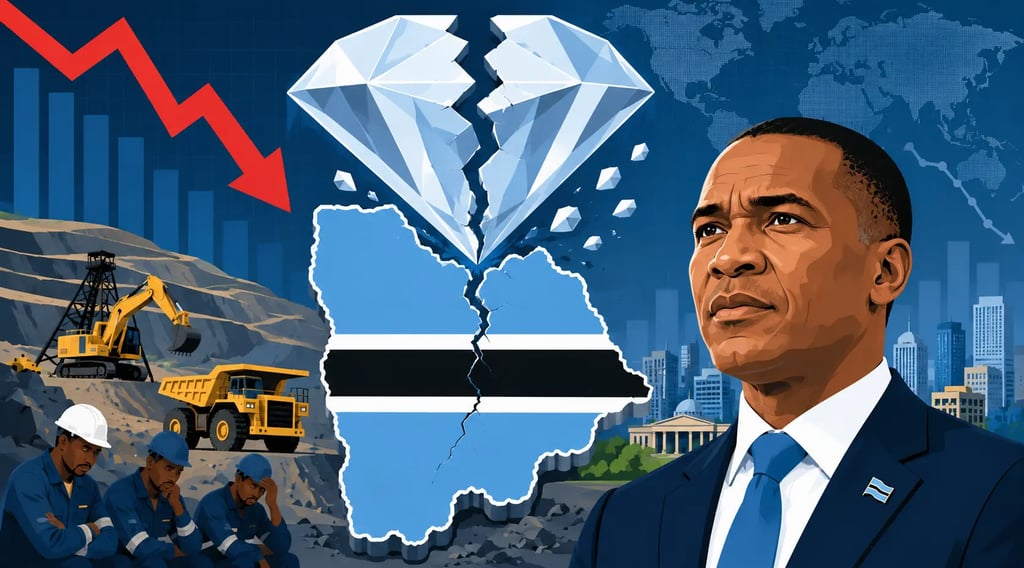
What if the very first thing that saved a country from poverty suddenly started losing its value? That's not hypothetical; that's Botswana's reality right now. Diamonds, which were once the ultimate symbol of permanence and luxury, are quietly losing their grip on the global market. And for a nation that bet almost everything in it, the consequences are playing out real this time.
Why are diamonds used to be so valuable?
Diamonds are more than just pretty stones. They formed deep within the Earth over billions of years ago under extreme heat and pressure. Natural diamonds are very rare, and along with their hardness and brilliance, they have become one of the world's most expensive gemstones.
Besides being used as jewelry, diamonds used to have other serious industrial use cases. Their extreme hardness makes them essential in the manufacture of cutting tools, drilling equipment, and precision manufacturing.
For developing nations especially, diamonds have historically been a fast track out of poverty. Infrastructure, education, healthcare—all of it can flow from a single thriving mine.
So What Went Wrong?
The simple reason would be lab-grown diamonds.
Scientists figured out how to replicate the exact carbon structure of a natural diamond in a controlled environment, which is faster, cheaper, and with a much smaller environmental footprint. A lab-grown diamond is chemically identical to a mined one. You cannot tell the difference with the naked eye.
The price gap, however, is obvious. Lab-grown diamonds now cost up to 80% less than natural ones. For consumers, especially younger buyers who are also more conscious about mining ethics, the choice isn't hard. Add to that reduced luxury spending in the US and China following the pandemic, and you have a market that simply hasn't bounced back. The appetite for natural diamonds has weakened, and there's no clear sign of a quick recovery.
Also, the industrial side demand also took a hit since lab-grown diamonds are cheaper, more consistent, and purpose-built for the job, leaving natural diamonds as a jewelry play.
Enter Botswana: Africa's Diamond Story
To understand why this matters so much, you need to understand what Botswana actually is.
In 1966, Botswana, a country in Southern Africa was among the poorest countries on Earth, landlocked, underdeveloped, and largely dependent on cattle farming. Then came diamonds. Large deposits were discovered shortly after independence, and the government made a decision that changed everything: instead of allowing foreign companies to take the profits, Botswana negotiated joint ownership.
The result was Debswana, a 50/50 partnership between the Botswana government and De Beers. Currently Debswana accounts for around 90% of Botswana’s diamond sales. Over the following decades, diamond revenues funded roads, hospitals, schools, and a rising middle class. Botswana went from one of the world's poorest nations to a middle-income economy within a single generation. It became the textbook example of how a resource-rich country should handle its wealth.
A Wealth Built on One Thing
Here's the honest picture from a finance standpoint: Botswana didn't just rely heavily on diamonds; it essentially built its entire economic model around them. Roughly one-third of the government's income comes from diamonds.
When one commodity accounts for the majority of your export earnings and a large chunk of government revenue, you don't really have an economy with a diamond sector. You have a diamond economy with everything else attached to it. That's a concentration risk most investors would never accept in a portfolio, yet it's how an entire country has been running for fifty years.
S&P Global Ratings downgraded Botswana's sovereign credit rating to BBB- in 2025, a signal that the outside world is starting to price in what was always the underlying vulnerability: too much riding on one stone.
Behind the credit ratings and production figures are actual people. This slowly translates directly into job losses, contract cancellations, and communities built around mines suddenly wondering what comes next.
The diamond downturn is no longer just a business issue. It is a human issue affecting workers, families, contractors, and entire mining communities. Many workers earn between $190 and $250 a month while the cost of living keeps climbing. Entire towns that grew alongside the mines are now exposed to the same fragility the broader economy has always carried.
Botswana isn't standing still. The government is actively pursuing paths to reduce its diamond dependence. Diversification efforts are targeting agriculture, tourism, copper mining, and information and communication technology. The country is also drawing interest as a potential hub for financial services and technology infrastructure in Southern Africa.
When citizens depend heavily on one sector, a fall in global demand becomes very damaging. It's the kind of observation that sounds obvious in hindsight but is genuinely hard to act on when the sector in question has been delivering for five decades.
Conclusion
Botswana's diamond story is genuinely remarkable. Few countries have turned natural resource wealth into such sustained development for their people. But the success of that model quietly created a vulnerability that's now impossible to ignore.
After the fall of diamonds, Botswana is now trying to capitalize on alternative markets such as copper, agriculture, tourism, and technology services to carry the economy forward. The question was never whether Botswana could survive a diamond slump. It's whether the country can build the next engine before the first one runs dry.
MacroUTC
Newsletter
© 2024. All rights reserved.
Contact