If China Takes Taiwan, What Happens to the Global Economy Next?
What if China takes Taiwan? Explore the Taiwan-China conflict, TSMC's global importance, and the economic impact on markets, AI, and semiconductors.
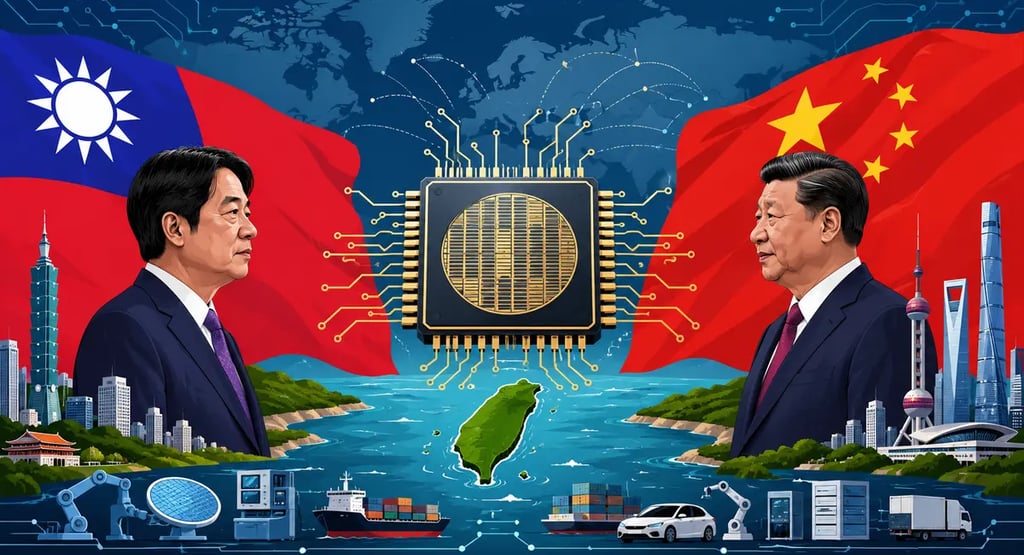
There is a small island, 36,000 square kilometres and home to 23 million people, sitting off the coast of China. Right now it is one of the most consequential places on Earth. Not because of its size. Not just because of its politics. But because of what it makes, who wants to control it, and what happens to the rest of us if that changes.
1. The Problem Between China and Taiwan
To understand the tension today, you need to go back to 1949.
China had just finished a long, brutal civil war. The Communist Party under Mao Zedong won and took control of the mainland. The losing side, the Nationalist government, retreated across the water to the island of Taiwan, set up their own administration, and called it the Republic of China (ROC).
Since that moment, two governments have both claimed to be the rightful ruler of China. Beijing, officially the People's Republic of China (PRC), insists Taiwan is a breakaway province that must eventually return to the mainland. Taipei has governed itself independently ever since, and it has done so rather well.
Here is the part that surprises many people: China has never actually governed Taiwan. Not once, not for a single day, since the PRC was founded in 1949. Taiwan has its own elected government, its own military, its own currency, its own courts, and its own passports.
Most Taiwanese people today are not pushing for formal independence, but they are certainly not asking for unification either. They want the current arrangement to continue, a kind of managed ambiguity that has held for over seven decades. Beijing has never been comfortable with that arrangement. And in recent years, the pressure from the mainland has grown.
2. How Big Is Taiwan's Economy and How Much of It Is TSMC?
Taiwan is not a wealthy place because of natural resources or land. It is a wealthy place because of what it learned to build.
As of mid-2026, Taiwan's stock market is worth roughly $4.9 to $5 trillion. That places it among the five largest stock markets in the world, ahead of the United Kingdom, France, and Saudi Arabia.
Here is the number that makes people stop and look twice: Taiwan's entire annual GDP is around $1 trillion. The stock market is worth five times the size of the whole economy. That is a remarkable gap, and it reflects something specific. Investors are not just valuing what Taiwan produces today. They are valuing its position at the centre of the global technology supply chain, a position that took decades to build and cannot be moved overnight.
The company responsible for most of this is Taiwan Semiconductor Manufacturing Company, better known as TSMC. It alone accounts for more than 40% of the entire value of Taiwan's stock market, worth somewhere between $1.7 and $1.9 trillion as of this writing.
Other major companies like MediaTek, Hon Hai, Delta Electronics, and ASE Technology are meaningful players in their own right. But TSMC is in a different category entirely. It is not just Taiwan's most important company. It is arguably one of the most important companies on Earth.
3. Why TSMC Matters to the Entire World
TSMC does not design chips. That is the first thing to understand about it.
Companies like NVIDIA, Apple, AMD, and Qualcomm spend years and billions of dollars designing the processors that go into phones, laptops, AI systems, and data centres. When the designs are ready, they need someone to actually manufacture them. For the most advanced chips in the world, that someone is almost always TSMC.
TSMC is a factory. And it is, by a significant margin, the best factory in the world for this work.
Chip manufacturing is measured in something called process nodes, which refers to how small the transistors on a chip are. Smaller transistors mean more power, better performance, and less energy used. TSMC has led the world in this for over a decade, from 7nm to 5nm to 3nm, with 2nm in development now. No other company manufactures leading-edge chips at the same volume or consistency.
The practical result of all this: when NVIDIA ships an AI chip, TSMC built it. When Apple released a new iPhone, TSMC made the processor inside it. The AI infrastructure buildout that has consumed hundreds of billions in investment over the past few years runs, in very large part, on chips that came out of factories in Taiwan.
A useful way to picture the global economy: oil is the fuel, electricity is the nervous system, and semiconductors are the brain cells. TSMC is one of the most important places on Earth that produces those brain cells. The United States depends on it for defence systems and cloud computing. Japan and Europe have both been working with TSMC to build new facilities on their soil, because they understand what happens if access to those chips is ever cut off.
4. What Would Actually Happen If China Took Taiwan?
This is where things stop being abstract.
Taiwan itself would change fundamentally. Today, Taiwan has competitive elections, multiple political parties, an independent press, and courts that operate outside Beijing's reach. A Chinese takeover, regardless of what form it took, would almost certainly bring those things to an end. The governing model Beijing uses at home and has applied to Hong Kong does not leave much room for the kind of political life Taiwan has built.
TSMC would become the world's most urgent problem. If a military conflict broke out, the physical factories could be damaged. The engineers who carry decades of manufacturing knowledge, knowledge that cannot simply be downloaded or transferred, would leave. Supply chains built over thirty years would freeze. The world would not just lose Taiwan's chip production. It would lose the capacity to replace it at speed, because there is no other facility anywhere that does what TSMC does at the same level.
Every company that relies on TSMC would face shortages for which there is no short-term fix. Smartphones, laptops, server farms, car electronics, hospital equipment, all of it would feel the impact. The chip shortage that disrupted the car industry during the pandemic years was caused by a demand spike. This would be a supply collapse. Far worse.
China would gain territory and lose almost everything else. Sanctions from the United States, Europe, Japan, South Korea, and others would follow. Foreign capital would leave. Access to global financial systems could be cut. China imports large quantities of semiconductors, many of them from TSMC. Cutting itself off from the global economy would hurt its own industry severely. Winning the island would not mean winning a functioning TSMC. And the economic cost of the fight, and everything that came after, could take a generation to recover from.
The United States would face a decision it has carefully avoided for decades. Washington has long kept a policy of deliberate vagueness, selling defensive weapons to Taiwan and expressing support for its ability to defend itself, but never making an explicit military commitment. A Chinese move would force that question into the open: intervene and risk direct conflict with a nuclear-armed state, or step back and accept a world where the most critical technology supply chain sits under Beijing's authority. Japan and South Korea, both close U.S. allies and both deeply dependent on Taiwanese chips, would face their own version of the same choice.
Markets would move before any of this was resolved. Technology stocks, built on assumptions of stable chip supply, would be hit hard and fast. Electronics prices would climb. Manufacturing across dozens of industries would slow. The geopolitical map of Asia, and the assumptions that underpin most long-term investment strategies, would need to be redrawn.
5. How Realistic Is a Chinese Takeover?
Honest answer: difficult to say with confidence, and anyone claiming certainty is working from guesswork.
What military and strategic analysts broadly agree on is this: a full invasion of Taiwan would be an enormously costly operation for China, far more costly than it might look from a distance. Taiwan has invested heavily in its defences, including weapons specifically designed to complicate an amphibious assault. The Taiwan Strait is one of the more difficult stretches of water on Earth to cross with a military force. And Taiwan would not be fighting alone. The United States, Japan, and potentially others would likely be involved in some form.
China's approach over the decades has been to apply sustained pressure rather than direct military action: naval exercises near Taiwan's coast, incursions into its air defence zone, economic leverage over countries that grow too close to Taipei, and diplomatic campaigns to reduce Taiwan's international recognition. That pattern of calibrated pressure has worked reasonably well for Beijing and carries far lower risk than an outright invasion.
But the situation is not static. China's military has grown substantially over the past twenty years. The window in which Taiwan's defences and U.S. deterrence might hold off an attack with confidence may not stay open indefinitely. Some analysts believe Chinese leadership has set internal timelines. Others think the economic cost of conflict, for China as much as anyone else, makes an outright invasion unlikely for the foreseeable future.
What can be said without much argument: the risk is real, it is not falling, and the consequences of getting it wrong are severe enough that governments, companies, and investors around the world are already making decisions based on it.
Conclusion
Taiwan is a small island in a permanent political argument with a very large neighbour. That argument has been running for 75 years without a final resolution, and for most of that time the world paid it limited attention.
That is no longer possible.
Taiwan sits at the centre of the global semiconductor industry in a way no other place does. Its most important company makes the chips that run the AI systems, smartphones, and data centres the modern economy depends on. And it does all of this while existing in a state of managed uncertainty with a government 180 kilometres away that has never accepted its right to exist independently.
The island is small. What happens there is not.
MacroUTC
Newsletter
© 2024. All rights reserved.
Contact