Why Global Unemployment Remains Low Despite Massive Layoffs Worldwide
Massive layoffs are happening worldwide, yet global unemployment remains low. Discover the economic factors keeping unemployment rates stable across industries.


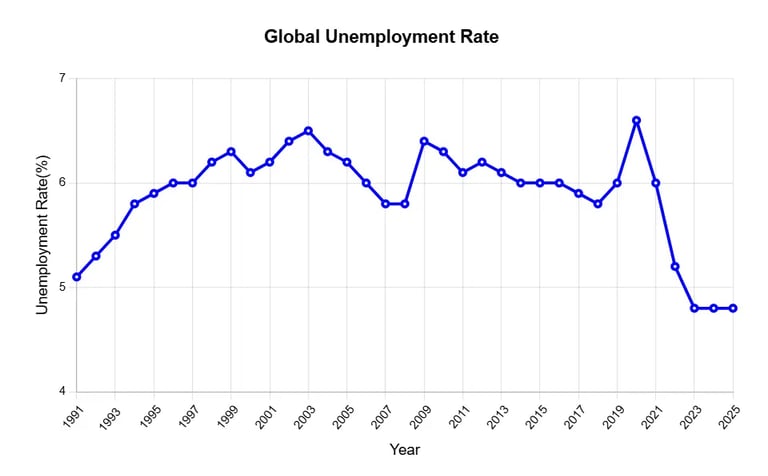
Over the past few years, headlines about massive layoffs in major companies like Amazon, Meta, and Alphabet have been dominating the internet. Despite the layoff numbers, the global unemployment rate is reducing every year and is currently at historical lows. These numbers also seem to be reducing every year.
Below is the global unemployment rate data from the World Bank.
As per the above data, massive layoffs and a low unemployment rate seem contradictory. If companies are laying off thousands of employees, the unemployment rate should naturally rise, but the global labor market is a bit more complex than how it has been represented.
The majority of the layoffs people hear about are from big tech companies, which have been viewed as jobs with stability and high pay. However, after years of rapid hiring and increasing AI-driven automation, the sector is no longer growing at the pace it once used to be. Institutional graduates who specialized in this field, now have low demand due to oversupply, changing hiring priorities, and slower entry-level hiring in parts of the industry.
One important point most people overlook is that the tech sector barely represents 1% of the global labor market, with the US as the highest leader, roughly with 7-8% employment. And since it is often associated with high salaries, strong career growth, and modern work culture, there tends to be a lot of competition, which further amplifies the rising trend. As the sector gets more saturated, many workers and graduates are now exploring alternative career paths and industries.
Excluding the tech sector, millions of jobs are still being created in healthcare, retail, logistics, construction, hospitality, manufacturing, and government services. Another major reason for these massive layoffs is that many companies over-hired during the pandemic era and are now correcting staffing levels.
Another thing worth mentioning is what unemployment numbers do and do not measure. Unemployment statistics count people who are engaged in economic activity as employed. These mostly include self-employed workers, freelancers, gig workers, business owners, and part-time workers. They don’t represent underemployment, unstable income, low-paying gig work, or people who have actively stopped searching for jobs.
Currently, the gig work and freelancing sectors are rising, and traditional self-employment, like small shops, farming, local trades, and informal businesses, is falling, which further dictates the unemployment rate. The economy is now slowly shifting from traditional blue-collar and routine-based office work toward more skill-based, service-oriented, and technology-driven white-collar roles. Job quality is also becoming more uneven, with increasing flexibility and gig-based work.
Overall, the labor market is not simply shrinking or expanding in one direction, but continuously evolving. The shift toward more flexible, skill-based, and technology-driven work is changing the structure of employment, even if headline unemployment numbers remain stable.
In this context, low unemployment does not necessarily reflect strong job quality, but rather a broader and more complex transformation of the global economy.
MacroUTC
Newsletter
© 2024. All rights reserved.
Contact