The Rise and Fall of UK Prime Minister Keir Starmer
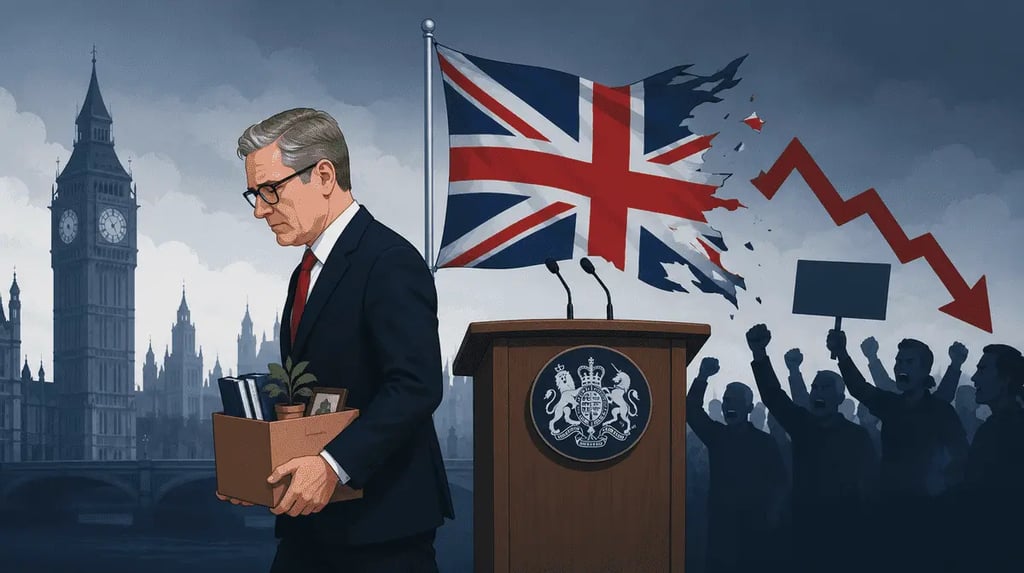
A landslide win. 13 U-turns. A massive Epstein scandal. Over 1,500 lost council seats. How UK Prime Minister Keir Starmer went from hero to completely gone.
The Man Who Had Everything, Then Lost It All
Two years. That's all it took for one of the most dominant electoral victories in British political history to completely unravel.
When Keir Starmer walked into 10 Downing Street in July 2024, the country was ready for him. After 14 years of Conservative rule and a revolving door of prime ministers that made the UK feel more like a reality show than a functioning democracy, Labour's landslide win felt like a reset. People wanted stability. They wanted someone serious.
On June 22, 2026, Starmer stood outside that same door and announced his resignation. Not because of a general election. Not because of some outside force. His own party had stopped believing in him.
So what happened? How does someone go from a historic majority to "please just leave"? Let's get into it.
How the UK Government Actually Works
Before the Starmer story makes full sense, you need a quick picture of how the UK runs because it's different from what many people outside the country expect.
The UK is a multi-party democracy, but two parties have historically dominated national politics: the Labour Party, which sits on the centre-left and traditionally speaks for workers and public services, and the Conservative Party, which leans centre-right and focuses more on business and lower taxes. In recent years, parties like Reform UK, the Liberal Democrats, and the Greens have started cutting into that traditional two-party hold but Labour and the Conservatives still dominate at the top.
Now, the monarchy. Yes, the UK has a king, King Charles III. And this is where a lot of people get confused. The king is not in charge. He doesn't set policy, can't dismiss the government, and doesn't run day-to-day affairs. The monarchy in the UK is ceremonial; the king opens Parliament, represents the country on the world stage, and reads out speeches that the government writes for him. When Starmer resigned, one of the first things he did was call King Charles to inform him of his decision not to ask for permission. That pretty much says it all.
The real power belongs to the Prime Minister and the Cabinet. The PM is the leader of whichever party wins a majority in the House of Commons. The government and the monarchy are entirely separate things. The king reigns; the Prime Minister governs.
The Landslide That Set the Stage
Labour's July 2024 victory was an enormous majority of 172 seats in Parliament. After years of political chaos under the Conservatives, the public was done waiting.
But here's the thing nobody said loudly enough at the time: Labour didn't win because people loved them. They won because people were exhausted by what came before. Starmer's government came in with the smallest vote share for any majority government since records were first kept in 1830. The mandate wasn't "we trust you completely" it was closer to "please just be different."
That's a shaky foundation. And it showed.
Why Starmer Fell Apart
The U-Turn Factory
Nothing kills a politician's credibility faster than saying one thing and then doing the complete opposite, especially more than once. Starmer turned this into a pattern.
The first major blow was the Winter Fuel Payment. This is a benefit that helps elderly and vulnerable people cover heating costs during the colder months. Labour cut it from millions of pensioners almost immediately after taking office. It was deeply unpopular. Hundreds of thousands of people signed petitions against it. After months of pressure, the government quietly walked it back.
Then came the Family Farm Tax, a proposed inheritance rule change that would have hit farming families hard. Farmers drove their tractors to Parliament in protest. After over a year of pushback, Labour backed down and significantly watered down the policy.
Starmer also made a big deal of launching a national digital ID scheme, framing it as modernisation and efficiency. Then came the public backlash, and the policy was quietly shelved.
In November 2025, the government announced a hike in business rates for pubs, thousands of which were already fighting to stay open. There was an immediate reaction. Labour did a partial U-turn, but the damage had already landed for many small business owners.
And perhaps the most tone-deaf move of all: Labour decided to delay 30 local council elections by a year, citing administrative reasons linked to local government reorganisation. The opposition accused the government of avoiding accountability. When Reform UK took the government to court, the legal advice that came back was that the delays could be unlawful and the government reversed course yet again. A U-turn on holding elections. That's not a great look for any democracy.
Each of these reversals, standing alone, might be forgiven. Stacked together, they painted the picture of a government that didn't know what it stood for and a Prime Minister who announced policies without fully thinking them through.
The Mandelson Catastrophe
If the U-turns were a slow bleed, the Peter Mandelson affair was a gut punch.
In December 2024, Starmer appointed veteran Labour politician Peter Mandelson as the UK's Ambassador to the United States. The logic was that Mandelson experienced, well-connected, a former EU trade chief could navigate the incoming Trump administration and help avoid damaging trade tariffs. And for a while, it even seemed to work. A UK-US trade deal was struck in May 2025.
Then the Epstein files landed.
In September 2025, the US Department of Justice released a trove of documents and emails related to convicted child sex offender Jeffrey Epstein. Among them were exchanges showing that Mandelson had maintained a close friendship with Epstein well after Epstein's 2008 conviction, not before, after. Starmer fired him immediately.
But the story didn't stop there. It later emerged that Mandelson had actually failed his security vetting in January 2025 before he even started the ambassador role. The Foreign Office had overruled the recommendation of security officials and pushed the appointment through anyway. Starmer claimed he was never told. Whether that's credible is something each person can judge for themselves, but it did not look good either way.
By February 2026, Starmer's own Chief of Staff, Morgan McSweeney who had reportedly been one of the loudest voices pushing for Mandelson's appointment resigned. The top civil servant at the Foreign Office was fired. British police eventually arrested Mandelson on suspicion of misconduct in public office.
Starmer had run for office on a promise to "clean up politics." Appointing someone with known ties to Epstein to the UK's most high-profile diplomatic post was about as far from that promise as you could get.
Voters Delivered Their Verdict
The public's frustration showed up hard in the local elections of May 2026. Labour lost 1,498 council seats and lost control of 38 councils, one of the worst results for a governing party in modern British history.
Reform UK was taking Labour's traditional working-class voters. The Greens were picking up younger, more progressive Labour supporters. Starmer's party was getting squeezed from both sides at the same time, and by November 2025, his net approval rating had fallen to -46%. Political commentators were drawing comparisons to Liz Truss, the Conservative Prime Minister who lasted just 45 days in office.
Andy Burnham: The Rival Within
While all of this was happening, someone was quietly waiting.
Andy Burnham had been the Mayor of Greater Manchester since 2017. Known as the "King of the North," he had built a strong reputation by actually delivering for his region, improving public transport, tackling homelessness, and generally making himself visible and accountable to the people who voted for him. He was everything Starmer was being accused of not being.
For months, Labour MPs who had stopped believing in Starmer began rallying around Burnham as a credible alternative. The technical problem was that Burnham didn't hold a seat in Parliament, which meant he couldn't formally challenge for the leadership.
So they created one. A Labour MP named Josh Simons resigned his Makerfield seat specifically to open a vacancy for Burnham. This was openly acknowledged and widely reported. Burnham ran in the resulting by-election on June 18, 2026, won with almost 25,000 votes and a majority of over 9,200, and was sworn in as an MP on June 22, 2026 the exact same morning Starmer announced his resignation.
That timing was not a coincidence.
The Cabinet Walks Out
Burnham wasn't the only one abandoning ship. Starmer's own government started falling apart from the inside.
Health Secretary Wes Streeting, once considered a future Labour leader himself, resigned in May 2026. Defence Secretary John Healey quit in June over disputes about military spending plans. The Director of Communications resigned. McSweeney, the Chief of Staff, was already gone. A senior Foreign Office official was publicly fired.
When your own cabinet is walking out the door, the writing isn't just on the wall — it's been spray-painted, framed, and mounted.
My Take on All of This
Here's the reality: Starmer's fall wasn't inevitable, but it wasn't exactly a surprise either.
He came into office with a historic majority and proceeded to spend the next two years undermining his own authority through poor judgment calls and constant policy reversals. Every time he drew a line, he walked it back. Every time he promised something, a version of the opposite seemed to follow.
The Mandelson appointment, specifically, is hard to defend on any level. The warnings were there before the appointment was made. The reputational risks were documented and flagged by his own staff. And the fallout ate up enormous political time and energy that should have been spent fixing public services and building economic stability. For a Prime Minister who ran on integrity, it was a self-inflicted disaster.
That said, the problems he inherited were real. Brexit had done genuine economic damage. Public services were stretched thin after years of Conservative underfunding. There was no easy route. But leadership means finding a way to manage those constraints while still giving people something to believe in. Starmer never managed to do that convincingly.
What This Means for Britain's Future
When Starmer steps aside, the UK will have had seven Prime Ministers in ten years. Let that sink in. Seven. In a decade. The kind of long-term planning that a country needs on housing, healthcare, economic growth, climate, infrastructure is almost impossible under that kind of constant leadership churn.
Andy Burnham is now the clear frontrunner to take over. He's popular, he has a concrete record in Manchester, and he projects the kind of confidence and groundedness that Starmer struggled to convey. Whether he can scale what he did for Greater Manchester up to an entire country is the real test ahead — running a region and running a nation are very different things.
But more than who the next Prime Minister is, the bigger question the UK needs to ask itself is this: why does it keep getting here? Why does political leadership keep collapsing before it can actually build anything?
That's the problem no by-election result or leadership contest is going to fix on its own.
The leadership contest is open, nominations close July 16, 2026, and a new Prime Minister is expected to be in place before Parliament returns in September.
MacroUTC
Newsletter
© 2024. All rights reserved.
Contact