"I think AI is more than…," SoftBank CEO Masayoshi Son's take on AI Bubble
Masayoshi Son is not afraid of an AI bubble; he's betting billions on it. Here's what SoftBank's CEO sees that most Wall Street experts are getting wrong.
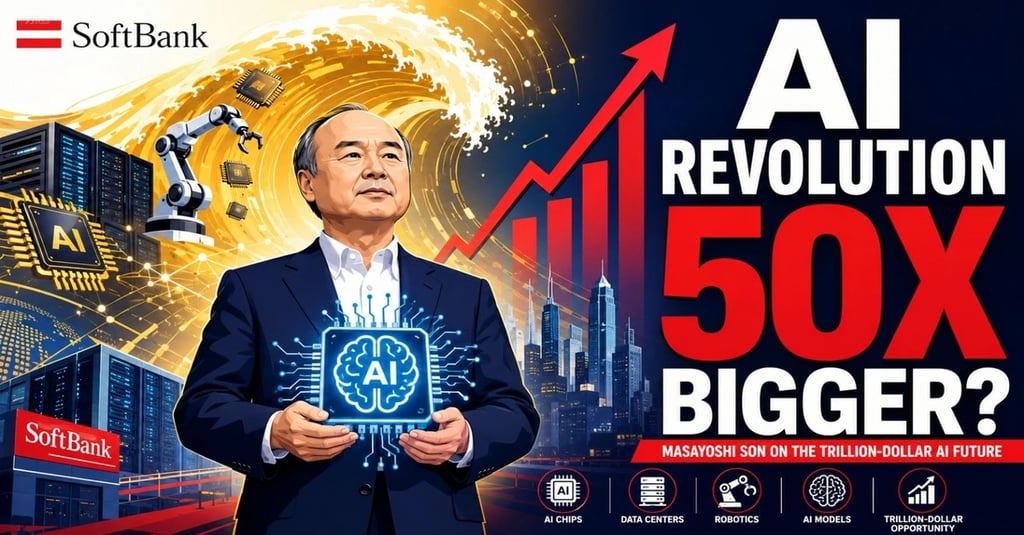
When analysts and economists started making noise about an AI bubble, Son walked into a Tokyo forum and told them, plainly, that they are "not smart enough" to understand what they're looking at.
What Son means when he says "AI is more than a bubble" isn't that the valuations are stretched but will eventually hold up. He's gone on record predicting AI will eventually make up at least 10% of global GDP, and that artificial superintelligence machines running 10,000 times smarter than any human are less than ten years out
Who Is Masayoshi Son?
Son was born in 1957 in Tosu, a small city in Saga Prefecture, Japan, to an ethnic Korean family with very little money.
In 1981, at 24, he started SoftBank with $50,000. SoftBank started as a software distributor. Then Son bought his way into telecom deals, media partnerships, and Silicon Valley access investing in Yahoo Japan before most Japanese companies took the internet seriously, striking a deal with Rupert Murdoch, acquiring Comdex. He moved fast and didn't wait for permission from anyone.
Then in 2000, after a single 5-minute conversation with an unknown entrepreneur named Jack Ma, Son wrote a $20 million check into a company called Alibaba.That position peaked at over $100 billion, making it arguably the single greatest venture bet ever made by a private investor.
The Vision Fund followed a $100 billion investment vehicle backed by Saudi Arabia's sovereign wealth fund. It was the largest fund of its kind ever created. It was also, in places, a disaster. WeWork nearly broke it. The pandemic hit the portfolio hard. SoftBank became the stock that business school professors used to explain what happens when ambition outruns judgment.
The NVIDIA Chapter: The One That Still Stings
In 2017, the Vision Fund put $4 billion into NVIDIA. This was before the world had connected the dots between GPU chips and the AI wave coming toward it. Son had connected those dots. He knew what NVIDIA's hardware meant for machine learning. He got in early.
Then came January 2019. NVIDIA's stock had been gutted down roughly 50% because the crypto mining boom had collapsed and taken chip demand with it. With the portfolio under pressure and the stock looking weak, SoftBank sold the entire NVIDIA position for $3.3 billion. On paper, that was a fine return.
Except.
By 2024, NVIDIA had become the most valuable chip company in history, briefly touching a $3.3 trillion market cap driven almost entirely by the explosion in AI computing demand. That 4.9% stake Son sold at a profit? It would have been worth somewhere above $157 billion.
At SoftBank's shareholder meeting, Son looked at the room and said: "The fish that got away was big."
SoftBank eventually bought back into NVIDIA around 2020, then sold again in late 2025 — this time for $5.83 billion to fund an even larger move into OpenAI and the Stargate AI project. Son said he was "crying" while selling. "I don't want to sell a single share," he told reporters. "I just had more need for money to invest in OpenAI."
What's striking is that Son wasn't wrong either time he sold. He was just always chasing something he thought was bigger. That's what makes him so hard to judge by the usual standards the things he regrets would be the high points of most investors' entire careers.
What Son Actually Thinks About AI
Most people in finance are asking: Is AI spending justified? Will the margins hold? Are we looking at 1999 again?
These are fair questions. They are also, in Son's view, the wrong ones.
Son's question is different: What actually changes when a machine gets smarter than the smartest human, across almost every field, simultaneously?
He has a name for it Artificial Superintelligence, or ASI and he expects it to show up within ten years. Not a slightly better chatbot. Not a faster search engine. He's describing something 10,000 times more capable than any individual human being, in nearly every area that matters.
In a CNBC interview, Son shared something OpenAI engineers had told him: a current AI model is now helping design the next one. The machine is writing part of its own successor. For Son, that's not a fun tech trivia fact, it's the signal he's been watching for. He uses ChatGPT two to three hours every day and says it's already smarter than he is in most subjects.
His near-term read: within two years, AI will outperform human intelligence in 70 to 80 percent of subjects. And in those areas, it won't be slightly better. It may be ten times sharper than the average person.
Physical AI is the next chapter he's betting on. SoftBank bought ABB's robotics business for $5.375 billion. He's co-leading Project Stargate, a $500 billion infrastructure buildout with Oracle and OpenAI.
His argument against the bubble comparison is blunt: the dot-com crash was about companies with no revenue and no product getting priced like they had both. What's happening with AI is something different a general-purpose shift in what machines can do, one that changes the cost structure of almost every industry on earth. You cannot "bubble" something that becomes as basic as electricity.
Final Thought: What It Actually Costs to Think Small
Masayoshi Son is asking questions that most people in serious finance still won't say out loud.
What if the bubble crowd is measuring the wrong thing? What if the real error isn't putting too much money into AI but putting in too little and watching the decade unfold from the sidelines?
Son has been early, then wrong, then early again, for four decades. The NVIDIA story is a case study in what a $157 billion mistake looks like when you're the one who made it. The Alibaba story is a case study in what happens when you back an instinct that nobody else at the table shares.
His current bet on AI, all of it, the infrastructure, the robotics, the OpenAI relationship is the biggest single move of his career. SoftBank's stock is up roughly 70% over the past year. The market isn't dismissing him.
Right or wrong, Masayoshi Son has never once bet against the future.
In this particular race, that might be the only bet that matters.
MacroUTC
Newsletter
© 2024. All rights reserved.
Contact