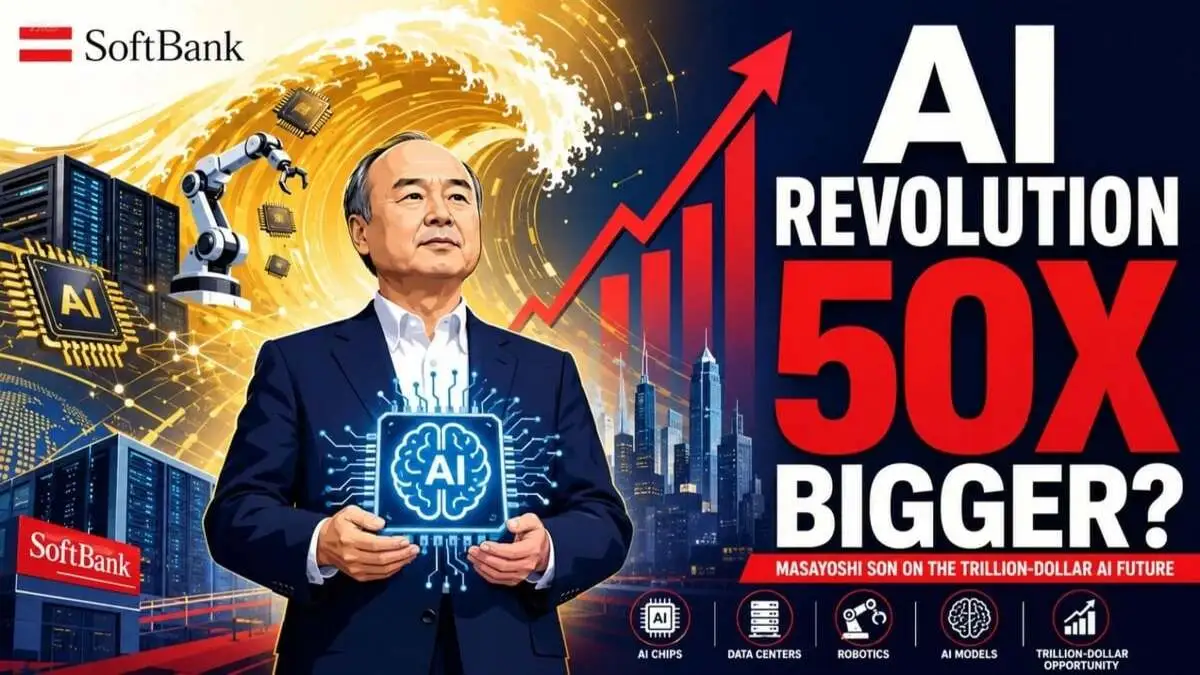
When analysts and economists started making noise about an AI bubble, Masayoshi Son walked into a Tokyo forum and basically told them that they were “not smart enough” to understand what they were looking at. That’s a pretty bold thing to say when the people you’re talking to are analysts and economists, but Son has never exactly been known for thinking small.
When Son says “AI is more than a bubble,” he isn’t simply saying that valuations are stretched but will eventually hold up. His view is much bigger than that. He’s gone on record predicting that AI could eventually make up at least 10% of global GDP, and that artificial superintelligence machines running at around 10,000 times the intelligence of a human could arrive in less than ten years. Basically, while everyone else is asking whether AI stocks are overpriced, Son is asking whether we’re actually spending enough.
Who the Hell Is Masayoshi Son?
Son was born in 1957 in Tosu, a small city in Saga Prefecture, Japan, to an ethnic Korean family with very little money. In 1981, at just 24 years old, he started SoftBank with $50,000. SoftBank began as a software distributor, but Son didn’t exactly stay in one lane. He moved into telecom deals, media partnerships, and Silicon Valley investments, including investing in Yahoo Japan before most Japanese companies took the internet seriously. He also struck a deal with Rupert Murdoch and acquired Comdex. The guy basically saw an opportunity and went, “Yeah, fuck it, let’s do it.”
Then came 2000. After a single five-minute conversation with an unknown entrepreneur named Jack Ma, Son wrote a $20 million check into a company called Alibaba. That position eventually peaked at more than $100 billion, making it arguably one of the greatest venture bets ever made by a private investor. Most people need five minutes just to decide what they’re ordering for lunch. Son apparently needed five minutes to find one of the greatest investments of his life.
The Vision Fund followed, a $100 billion investment vehicle backed by Saudi Arabia’s sovereign wealth fund. It was the largest fund of its kind ever created. It was also, in some places, a complete fucking roller coaster. WeWork nearly broke it, the pandemic hit the portfolio hard, and SoftBank became the stock that business-school professors could use to explain what happens when ambition gets way ahead of judgment.
The NVIDIA Chapter: The One That Still Stings
In 2017, the Vision Fund put $4 billion into NVIDIA. This was before the world had fully connected the dots between GPU chips and the AI wave that was coming. Son had already started connecting those dots. He understood what NVIDIA’s hardware could eventually mean for machine learning, and he got in early.
Then came January 2019. NVIDIA’s stock had been gutted by roughly 50% after the crypto-mining boom collapsed and took chip demand down with it. With the portfolio under pressure and NVIDIA’s stock looking weak, SoftBank sold the entire NVIDIA position for $3.3 billion. On paper, that was a perfectly fine return. Nothing to cry about.
Except NVIDIA went completely nuclear afterward.
By 2024, NVIDIA had become the most valuable chip company in history, briefly touching a $3.3 trillion market capitalization as demand for AI computing exploded. That 4.9% stake Son sold at a profit would have been worth somewhere above $157 billion. So yeah, technically he made money. He just left an absolutely ridiculous amount of money on the table.
At SoftBank’s shareholder meeting, Son looked back at the decision and said, “The fish that got away was big.” That might be one of the biggest financial understatements ever made.
SoftBank eventually bought back into NVIDIA around 2020, then sold again in late 2025, this time for $5.83 billion to help fund an even larger move into OpenAI and the Stargate AI project. Son said he was “crying” while selling. “I don’t want to sell a single share,” he told reporters. “I just had more need for money to invest in OpenAI.”
What’s interesting is that Son wasn’t necessarily wrong either time he sold. He was just always chasing something he believed was bigger. That’s what makes him so difficult to judge by the usual standards. The mistakes he regrets would be the high points of most investors’ entire careers.
What Son Actually Thinks About AI
Most people in finance are asking the usual questions. Is AI spending justified? Will the margins hold? Are we looking at another 1999? These are perfectly reasonable questions, but in Son’s view, they are also missing the bigger picture.
Son’s question is different: What actually changes when a machine gets smarter than the smartest human across almost every field, simultaneously? He has a name for it, Artificial Superintelligence, or ASI, and he expects it to show up within ten years.
He’s not talking about a slightly better chatbot or a faster search engine. He’s describing something potentially 10,000 times more capable than an individual human being in almost every area that matters. Basically, we’re not talking about asking ChatGPT to write your email a little faster. We’re talking about what happens when the machine becomes better than us at almost everything. That’s a slightly bigger problem.
In a CNBC interview, Son shared something OpenAI engineers had told him: a current AI model is now helping design the next one. The machine is helping build part of its own successor. For Son, that’s not just some fun technology trivia. That’s the kind of signal he’s been watching for. He also says he uses ChatGPT for two to three hours every day and believes it is already smarter than he is in most subjects.
His near-term prediction is even more aggressive. Within two years, Son expects AI to outperform human intelligence in 70% to 80% of subjects. And in those areas, he doesn’t think it will simply be slightly better. He believes it could be around ten times sharper than the average person.
Physical AI is the next chapter he’s betting on. SoftBank bought ABB’s robotics business for $5.375 billion, and Son is also co-leading Project Stargate, a $500 billion infrastructure buildout with Oracle and OpenAI. So while some people are still arguing about whether AI is actually intelligent, Son is already trying to build the infrastructure around the thing.
His argument against the bubble comparison is pretty straightforward. The dot-com crash involved companies with little or no revenue and little or no actual product being valued as if they were going to conquer the universe. What’s happening with AI, according to Son, is something different. He sees it as a general-purpose technological shift that changes what machines can do and potentially changes the cost structure of almost every industry on Earth.
You can’t really “bubble” something that eventually becomes as basic as electricity. At least that’s the bet Son is making.
Final Thought: What It Actually Costs to Think Small
Masayoshi Son is asking questions that most people in serious finance still aren’t comfortable saying out loud. What if the bubble crowd is measuring the wrong thing? What if the real mistake isn’t putting too much money into AI, but putting in too little and watching the next decade unfold from the sidelines?
Son has been early, then wrong, then early again for roughly four decades. The NVIDIA story is a case study in what a $157 billion mistake looks like when you’re the person who made it. The Alibaba story is the other side of the equation, a case study in what happens when you trust an instinct that almost nobody else at the table shares.
His current bet on AI, all of it, the infrastructure, the robotics, the OpenAI relationship, and Stargate, is arguably the biggest move of his career. SoftBank’s stock is up roughly 70% over the past year, so the market clearly isn’t treating him like some random dude yelling about AI from his basement.
Does that mean Son is right? Not necessarily. AI could still be massively overvalued. Some companies could get absolutely destroyed, and some of the money being thrown into AI could look completely fucking stupid in hindsight.
But Son has never really been interested in playing it safe. For four decades, he has basically followed the same philosophy: bet on the future before everyone else figures out what the hell is happening.
Sometimes that makes him look like a genius. Sometimes it makes him look like a complete lunatic. And occasionally, those are the same thing.
Right or wrong, Masayoshi Son has never been particularly interested in betting against the future. And in this particular race, that might be the biggest bet of them all.