
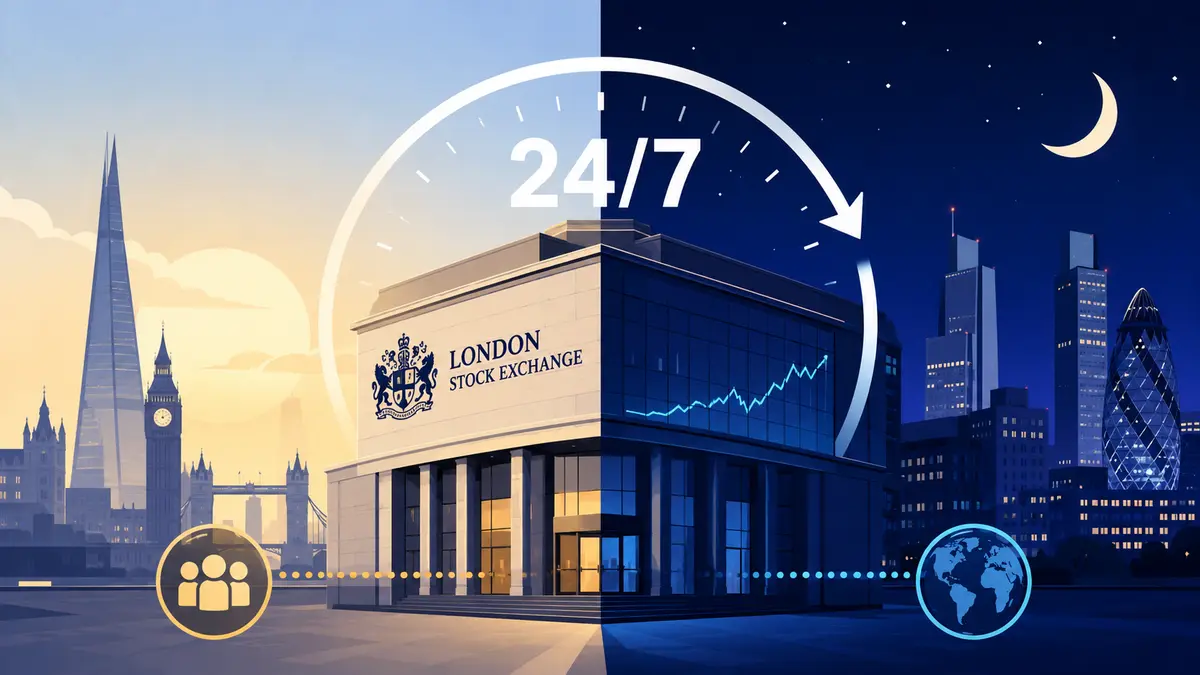
For as long as most investors can remember, Big Ben has struck 4:30pm and the London Stock Exchange has gone quiet for the day. That routine is about to end. London Stock Exchange 24/7 trading is no longer a distant idea, it’s a real plan with a real launch date, and it says a lot about how much investing has changed in just a few years.
Just How Big Is the London Stock Exchange?
Before getting into what’s changing, it helps to know the exchange itself. The London Stock Exchange, or LSE, has been open for business for more than two centuries, and it’s still very much a working market rather than a museum piece. Between its main board and its smaller-company AIM segment, it lists more than 2,000 companies, everything from household-name banks to small firms still finding their footing.
It also runs one of the longer trading days among major exchanges. The main session opens at 8am and closes at 4:30pm London time, pausing for just two symbolic minutes around midday. Add the ten-minute opening auction and the five-minute close that bookend the day, and traders get roughly eight and a half hours to get things done.
New York, by comparison, packs its business into a tighter six and a half hours, opening at 9:30am and closing at 4pm Eastern time. On paper, London already gives investors more time in the day than Wall Street does.
Trading hours and market size, though, aren’t the same thing, and that difference turns out to matter a great deal.
What’s Actually Changing at the LSE
The London Stock Exchange has announced a new night-time trading venue, set to launch in the first half of 2027. It won’t simply stretch the current market’s hours. Instead, it will be a separate venue that sits alongside the main exchange rather than replacing it.
The main market keeps its familiar 8am to 4:30pm hours. The new overnight venue will run from 5pm through to 7:50am the next morning, with a short pause around 6:30pm for end-of-day processing. Keeping the two venues separate also lets London sidestep much of the regulatory and operational complexity that would come with simply extending the main market’s hours into the night.
At launch, the venue won’t handle individual shares. It will focus on exchange-traded products, a category that includes funds tracking major indices, and the LSE already lists more than 2,600 of them. The first wave of overnight trading will center on funds tracking UK and US markets, giving investors a way to react to news without waiting for the next morning’s opening bell.
Why Is London Doing This Now?
The honest answer is competition, and much of it comes from outside traditional finance altogether. Crypto exchanges like Coinbase and Kraken have spent years giving investors round-the-clock access through nothing more than a smartphone app. That constant availability has especially appealed to younger, everyday retail investors, who’ve grown used to trading whenever they feel like it, day or night.
Traditional exchanges have taken notice. Extended trading hours are quickly becoming less of a novelty and more of a competitive necessity, and London doesn’t want to be left explaining why its market keeps banker’s hours while crypto never sleeps.
There’s a blunter, size-related reason too. The New York Stock Exchange alone lists over 2,000 companies worth a combined $39 trillion, several times London’s total market value of roughly $4 trillion. London simply can’t out-muscle New York on a raw scale. So it’s competing on something the size numbers don’t capture: a time zone that sits neatly between Asia and the Americas, an edge no US or Asian exchange can easily replicate.
There’s a second pressure point too. London has faced a prolonged drought in new stock market listings, and the UK government has been pushing hard to make the city more attractive to companies weighing an IPO. A modern, always-on trading venue is one way for the exchange to argue that it’s still evolving rather than standing still.
LSE Chief Executive Julia Hoggett has leaned into that geographic edge directly, arguing that extending trading into the overnight hours could let the exchange capture more of the demand sitting between the Asian and American sessions. It would give investors there a way to react to breaking news in real time, rather than waiting for London to open the next morning. Institutional investors, the pension funds, asset managers, and banks that drive most of the market’s real trading volume, have so far responded with noticeably more caution than retail traders have.
London Isn’t Acting Alone
If this all sounds familiar, that’s because it is. Several major exchanges have already announced similar plans, and the LSE is arguably playing catch-up rather than leading the charge.
Nasdaq is preparing to extend its trading day to 23 hours on weekdays starting in December. Cboe Global Markets is planning something similar, with 23-hour, five-day trading for US equities on its EDGX exchange, also launching in December. CME Group already introduced fully continuous, round-the-clock trading for cryptocurrency futures and options back in late May, one more sign of how blurred the line between traditional finance and crypto has become.
Even the biggest names on Wall Street are hedging their bets. BlackRock, JPMorgan, and Goldman Sachs have all taken part in a tokenization trial run through the Depository Trust and Clearing Corporation, exploring what it might look like to represent traditional stocks as tokens that could, in theory, trade far outside normal market hours.
The Upside: A Bigger, More Connected London
If the plan works as intended, London stands to gain quite a bit. A functioning overnight venue would turn its geographic quirk, sitting between Asian and American trading hours, into a genuine business advantage rather than just a talking point.
It could also help win back retail investors who’ve drifted toward crypto platforms purely for the convenience of round-the-clock access. There’s a forward-looking angle here too: Hoggett has said the exchange wants to build automated, AI-driven trading tools into the new venue, which could keep things running efficiently even while human traders and brokers are asleep.
The Risks: Trading in the Dark Has Its Downsides
None of this comes without trade-offs, and the biggest one is liquidity, how easily an asset can be bought or sold without moving its price. Markets work best when plenty of buyers and sellers are active at the same time, which keeps prices stable and spreads tight.
Overnight sessions, almost by definition, draw far fewer participants than the standard trading day. Thinner volume tends to mean wider spreads and choppier price swings, exactly the environment that can catch retail investors off guard, and part of why institutional investors have been slower to warm to the idea themselves.
There’s a fragmentation risk too. Splitting trading across two separate venues, one for the day and one for the night, could dilute overall liquidity rather than simply adding more trading time on top of it. Whether London can build up enough steady demand to make the night venue genuinely useful, rather than a mostly empty room with the lights left on, remains an open question.
The Bottom Line
London Stock Exchange 24/7 trading is one of the clearest signs yet that even the oldest financial institutions can’t ignore how much investor behavior has changed. Crypto platforms didn’t just create a new asset class, they reset expectations about when and how people should be able to trade at all.
Whether this move genuinely revitalizes London’s markets or just keeps the lights on for a quiet overnight session depends on whether enough investors, and enough liquidity, actually show up after dark. Either way, it’s a fascinating experiment to watch play out. What do you think, is round-the-clock trading a smart evolution for global markets, or a solution looking for a problem? Share your thoughts in the comments below.