If you have been into media and politics for a long time, you would have heard a lot of narratives. A story is often presented from one angle that represents the state representatives in a good way, while completely ignoring the other angle where the people are getting fucked. We will talk about the other angle here.
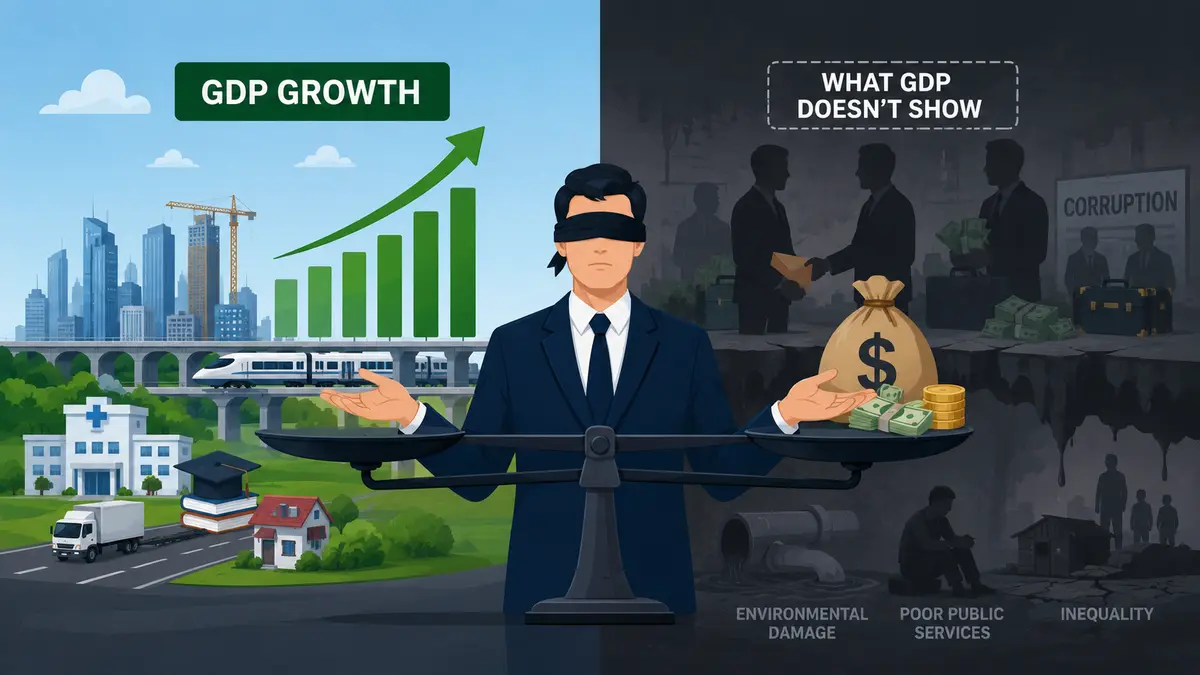
GDP tends to be one of the angles that governments like to represent because if GDP grows, it fits their narrative. If it shrinks, they won’t talk about it and try to misrepresent it. Well, GDP itself is not a bad indicator, but it tends to be misleading when a country is highly corrupt or there is massive wealth inequality.
First, let’s see how GDP and corruption levels are calculated. GDP, in general, means the value of goods and services produced in a country in a given year. It represents output, but it does not care about quality or efficiency.
Corruption levels, on the other hand, can be measured using an index called the Corruption Perceptions Index. A higher score indicates low corruption, and a lower score indicates higher corruption. For example, look at Denmark, which consistently ranks among the least corrupt, compared to South Sudan, which ranks among the most corrupt. You will see a pattern here: less corruption usually aligns with higher income levels. So, what does that mean?
Let’s take an example. Say there is a corrupt politician who has been given a road development project. Say the value of the project is $10 million. Now, from that $10 million, $4 million goes straight into the politician’s pocket. And with the rest, poor-quality roads are developed.
Now, according to government data, the government has still spent $10 million on the project, not $6 million. And the story does not end here. Since the roads are bad, they need maintenance, and in order to do it, the government again sends another, say, $2 million. Now, another round of corruption begins. From the $2 million, again, $1 million is looted, and bad roads are built again.
And again, the economic activity associated with the $2 million repair project is counted, not just the $1 million that actually goes into the road. Hence, this goes on and on.
Also, the money that these people loot often goes to other well-developed countries with lower corruption levels. Since they need to launder the money through offshore accounts, they move it outside. If that money is later spent or invested in those countries, the resulting economic activity can indirectly contribute to their GDP even more.
The GDP of a least-corrupt country tends to represent the value it actually produces. But the GDP of a highly corrupt country can give a distorted picture of the value being generated. GDP represents economic activity, but it does not represent efficiency or value. As long as qualifying economic activity takes place, it counts. On paper, it seems like a country is growing, but in reality, it involves a lot of wasted effort.
Another problem is misallocation. Say you are a corrupt politician and you have two projects in front of you. One is a highway project, and another is an online government service project. The second one, even though it is much needed, would not be picked since the first one is easier to loot.
So, by default, these corrupt economies tend to move towards more corruption, which can eventually push even more resources toward inefficient projects. People coming from highly corrupt countries would notice that their government websites are poorly developed, and the government tends not to give a shit about it because there is no money to loot there.
And not to mention, metrics like GDP per capita also do not tell the whole story since high wealth inequality can make the average look much better than what a typical person actually experiences.
In the end, corruption does not just hinder growth; it alters the structure of the economy itself. It turns the cycle into repair, waste, and inefficiency. In numbers, GDP might seem big, but in reality, it is stuck in fixing the same issues over and over again.