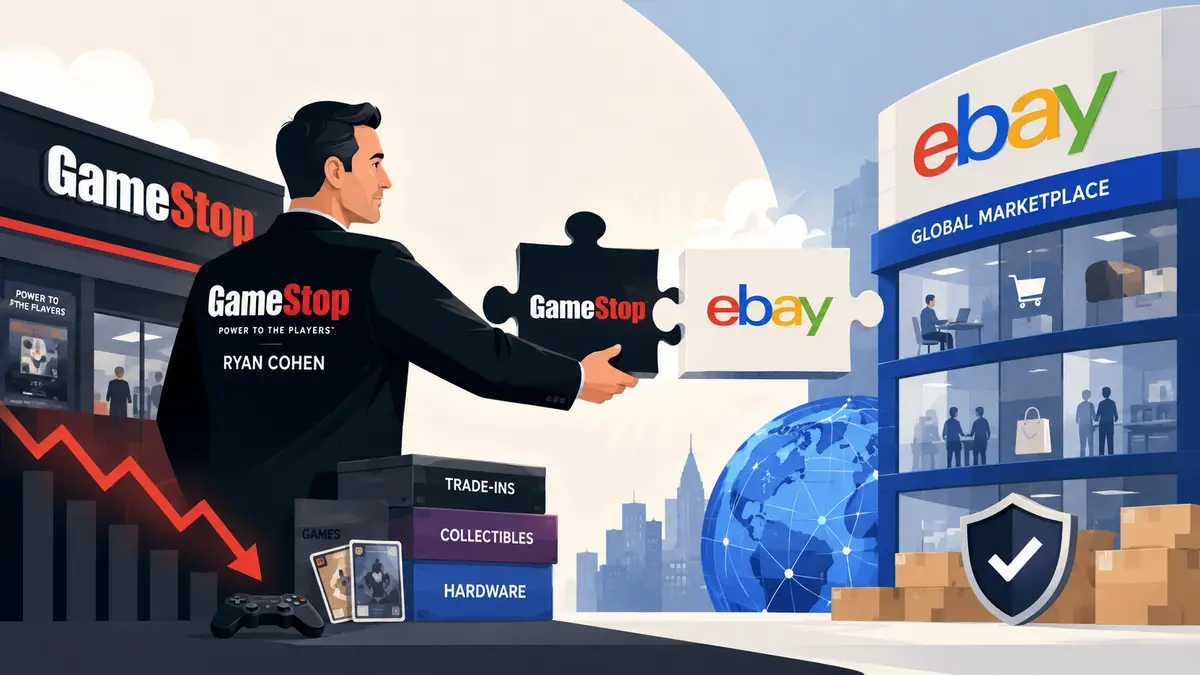
Not long ago, GameStop was known less as a business and more as a meme. The name went viral in 2021 when a Reddit trader nicknamed “Roaring Kitty” turned a stake in the video game retailer into one of the biggest short squeezes Wall Street had ever witnessed. Five years later, GameStop is making headlines again, and this time it isn’t about a stock rally. GameStop’s bid for eBay, a company nearly five times its size, has turned a struggling retailer into one of the more unlikely acquirers in recent corporate history.
What Is GameStop’s Business Model?
GameStop is an American specialty retailer built around physical stores that sell gaming hardware, software, and collectibles. Its defining feature, though, has always been the used game trade. The company buys pre-owned games from customers at a discount, then resells them at a healthy markup, turning secondhand inventory into one of retail’s highest-margin businesses.
That idea didn’t originate at GameStop. FuncoLand pioneered the buy-and-resell model in the 1990s, building an entire business around trading used games long before GameStop existed. When GameStop later acquired and rebranded FuncoLand’s stores, it scaled the concept into a nationwide chain and made trade-ins one of the most recognizable practices in video game retail (for a deeper breakdown, Vizologi’s GameStop business model canvas maps out the pieces well).
Alongside trade-ins, GameStop earns from new release sales, hardware, and a fast-growing collectibles and trading card segment. Together, these pieces form GameStop’s business model: buy low, sell high, and keep gamers coming back to the same counter.
Why GameStop’s Business Is Struggling
The trouble is that fewer people walk up to that counter every year. Digital downloads let gamers buy and store entire libraries without ever touching a disc, which quietly erodes the trade-in economy GameStop built its identity on.
GameStop’s limited international footprint makes the problem worse. The company operates in a relatively small number of countries, which restricts its ability to tap into fast-growing gaming markets abroad the way digital-first platforms can.
Even GameStop’s own online store struggles to compete with digital distribution giants like Steam, the PlayStation Store, and the Xbox marketplace, all of which sell directly to players with no shipping and no shelf space involved. On top of that, in the used and refurbished hardware space, GameStop competes with retail heavyweights like Amazon, Best Buy, and Walmart. The business is being squeezed from the digital side and the traditional retail side at the same time.
How GameStop Is Trying to Save Itself
Facing a shrinking core, GameStop has been quietly reshaping itself. Physical games still sell, but they’re no longer the centerpiece. The company has instead leaned harder into hardware, accessories, collectibles, trading cards, and refurbished electronics, categories with steadier demand and often better margins than a shrinking disc business.
That pivot is part of why eBay entered the picture. GameStop has its own e-commerce site, but it comes nowhere close to the global reach the company would need to compete internationally. eBay, on the other hand, already operates as a trusted global marketplace for used and collectible goods, exactly the territory GameStop is trying to expand into. Buying eBay wouldn’t just diversify GameStop’s revenue, it would hand the company a ready-made worldwide storefront it could never realistically build on its own.
What Is eBay, and Why Does GameStop Want It?
eBay is an American e-commerce company built around a two-sided online marketplace, meaning it connects buyers and sellers rather than selling products itself. It never owns or stores any of the inventory that changes hands on its platform. Instead, it earns revenue by charging sellers listing fees, final value fees on completed sales, advertising fees, and payment processing charges.
That marketplace design benefits from what’s known as network effects: a larger pool of buyers attracts more sellers, and more sellers in turn attract more buyers, reinforcing eBay’s position every time the platform grows. Online auctions existed before eBay, but the company was the one that turned the concept into a trusted, global, everyday way to buy and sell used and collectible items (Vizologi’s eBay business model canvas breaks down how that model works in more detail).
For GameStop, that history matters. eBay’s business model already carries the trust, scale, and international reach that GameStop’s own trade-in operation lacks, which is exactly why Ryan Cohen has framed a combination as a natural fit rather than a stretch.
Inside GameStop’s Bid for eBay
Here’s where the story turns audacious. eBay is roughly five times GameStop’s size, so this isn’t a routine acquisition. It’s closer to a minnow trying to swallow a much larger fish. The proposed GameStop acquisition of eBay would combine a century-old-in-spirit online marketplace with a video game retailer trying to reinvent itself.
In May 2026, GameStop CEO Ryan Cohen sent eBay’s board an unsolicited, non-binding proposal to acquire the company for $125 per share in a 50/50 cash-and-stock deal, valuing eBay at roughly $56 billion. At the time, GameStop disclosed it already held about a 5% economic stake in eBay through a mix of shares and derivatives.
eBay’s board didn’t welcome the offer. Chairman Paul Pressler rejected it days later, calling the bid “neither credible nor attractive,” and analysts quickly raised doubts about how GameStop, a company worth a fraction of eBay’s value, would actually finance a deal this large.
Cohen didn’t back down. He withdrew a proposed $35 billion pay package tied to his own performance, saying he wanted to focus entirely on the eBay acquisition, and publicly committed $500 million of his own money to the deal to prove he had real skin in the game. Months later, in a Bloomberg interview, he declined to say whether he’d raise the offer, but made his intentions plain: the company was “coming for eBay one way or another.”
Rather than walk away after the rejection, GameStop kept buying. Through a series of stock purchases and settled derivative contracts, the company grew its position from a 5% economic interest to a direct 9.8% ownership stake by mid-July 2026, making it eBay’s largest outside shareholder. The pattern is clear: ask nicely first, get rejected, then start buying influence one share at a time.
What Happens Next: Three Paths Forward
Buying a company five times your own size rarely happens quickly, and GameStop still faces a steep climb. Broadly, three paths remain open.
The first is a friendly acquisition, where GameStop raises its offer enough that eBay’s board eventually agrees to negotiate. This is the cleanest outcome, but it likely requires a higher price and much stronger proof of financing than eBay’s board has seen so far.
The second is a hostile takeover, a term for when an acquirer bypasses a company’s board and appeals directly to shareholders, betting that investors will either pressure the board into a deal or vote in directors who support one. Cohen has hinted at exactly this path by repeatedly refusing to rule it out.
The third is the slow build already underway: keep buying shares gradually, as GameStop has been doing, and use that growing stake to eventually push for board seats and replace directors who oppose the deal. This route takes longer, but it doesn’t depend on eBay’s current leadership ever saying yes.
Every path carries real risk. Closing a deal this size would likely require significant new debt, even with GameStop’s roughly $9 billion in cash and a financing commitment of up to $20 billion from TD Securities. That leverage could strain the combined company for years, and merging two businesses of such different scale and culture rarely goes as smoothly on paper as it does in a boardroom pitch.
Final Thoughts
Whether GameStop actually lands eBay or not, the attempt says something bigger about where the company sees its future. This isn’t the same GameStop that nearly collapsed a few years ago. It’s a business betting big on a marketplace many times its size, led by a CEO who has put his own pay and his own money behind making the bet work.
Do you think GameStop can pull off buying a company five times its size, or is this ambition running ahead of reality? Let us know what you think in the comments.