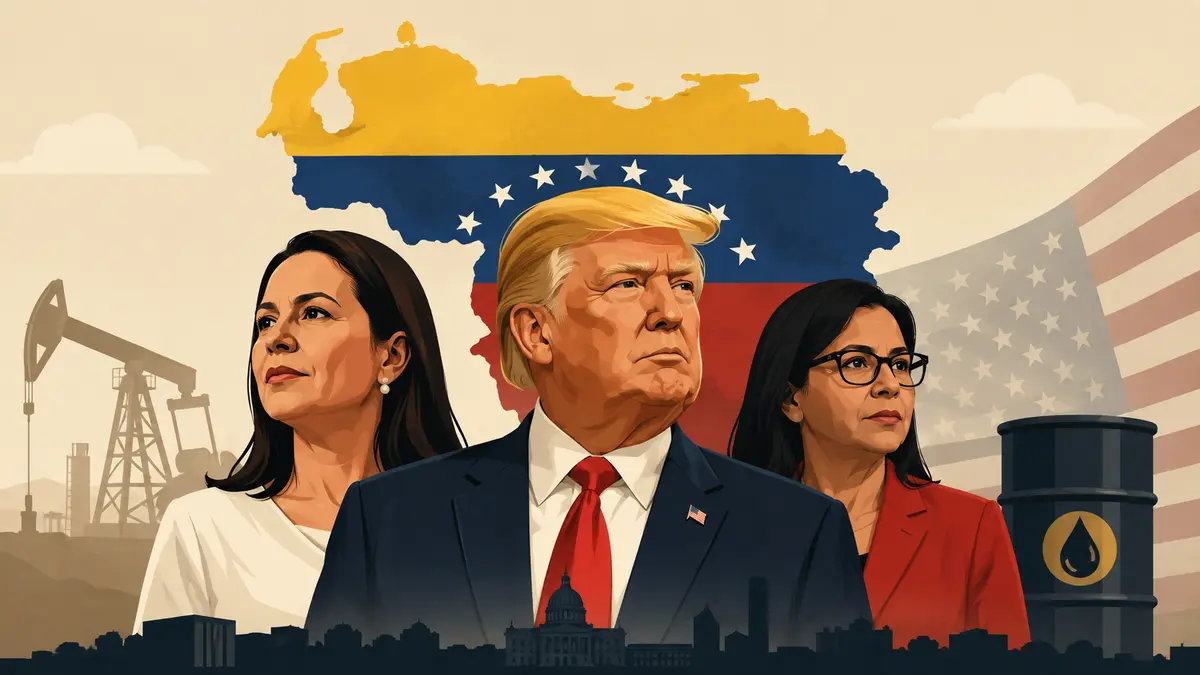
It all started almost a year ago when U.S. President Donald Trump, after begging and threatening the Norwegian Nobel Committee to give him the Nobel Peace Prize, still saw them decide to go with Venezuelan opposition leader María Corina Machado.
Then, a few months later, Trump’s administration basically capped the ass of Venezuelan dictator Nicolás Maduro in a middle-of-the-night raid in Caracas. Maduro was captured and taken to the United States to face federal charges. The whole thing completely changed the political situation in Venezuela overnight.
Anyway, this turned out to be one of the greatest victories Donny has ever seen. Hearing the happy news of Maduro being captured and the U.S. now having significant control over Venezuela, Machado met Trump at the White House. She even gave him her Nobel medal. But things didn’t exactly go the way she probably expected.
Trump happily accepted the medal, but that obviously did not mean he suddenly decided to hand Venezuela over to Machado. The Nobel Committee later made it clear that Machado could give away the physical medal, but she couldn’t transfer the Nobel Prize itself. Basically, Donny got the trophy but not the actual Nobel. Close enough, I guess.
After Maduro’s capture, opposition politicians who had spent years in exile started returning to Venezuela. They gathered around the U.S. presence in Caracas to discuss what the future of Venezuela was going to look like. These people had stayed outside the country because returning under Maduro could have meant getting arrested or worse. Now, suddenly, thanks to the U.S. taking control of the situation, they were back in the game.
Now, since the U.S. had enormous economic and political leverage over Venezuela, you might think they would back María Corina Machado. She had become one of the most popular opposition figures in the country and was widely seen as the face of the anti-Maduro movement.
But nope.
Instead, the U.S. moved forward with Delcy Rodríguez, who had served as Maduro’s vice president and held several senior positions in his government. Yep, they removed the dictator and then kept a major figure from the same political system in charge. At this point, Venezuela’s political transition started looking less like a clean democratic reset and more like changing the boss while keeping half the management team.
When people criticised this, the U.S. argument was basically that Venezuela needed a smooth transition rather than complete political chaos. Washington didn’t want the country to collapse, and it also wanted stability in the oil industry.
Yes, you heard that right.
Oil.
Even though the U.S. claims it is guiding Venezuela toward a democratic transition, the people involved in the negotiations are not exactly the opposition dream team. Jorge Rodríguez, Delcy Rodríguez’s brother, has been one of the key figures involved in negotiations. And instead of putting Machado at the centre of the opposition negotiations, Washington backed Dinorah Figuera, a much less prominent opposition figure.
At this point, it looks like the U.S. basically yeeted María Corina Machado into the political shadow realm and put Venezuela’s democracy project on airplane mode.
Even former U.S. Venezuela envoy Elliott Abrams criticised the decision, saying that nobody in the Venezuelan opposition would have selected Figuera as its representative. That tells you how unusual the choice was.
And the reason Machado’s supporters are so pissed off is pretty obvious. While many opposition politicians eventually fled Venezuela, Machado remained one of the most visible figures fighting Maduro’s government, despite the risks. She became the symbol of the opposition partly because she stayed in the fight when doing so was dangerous.
So, after all that, she gets the Nobel Prize, meets Trump, hands him her medal, and still ends up watching Washington negotiate with people from the old political establishment.
Politics is beautiful, isn’t it?
Machado has also been careful about openly attacking the transition. She has declined to comment on some of the negotiations and has said that whatever decisions are ultimately made, she should not be held responsible for them.
Now coming to business, Trump recently announced what he called “the biggest oil deal in world history.” Let’s see what it is.
The deal gives the United States major control over a huge portion of Venezuela’s oil reserves through a new arrangement involving American interests and Venezuelan authorities. The agreement covers 17 oil fields and is supposed to attract massive investment into Venezuela’s broken-down oil industry. Trump says the deal will eventually help lower American fuel prices and strengthen U.S. energy security.
And this is where the whole Venezuela story starts making a lot more sense.
The United States didn’t just remove Maduro and walk away. It now has enormous influence over Venezuela’s political transition and its oil industry.
Venezuela has the world’s largest proven oil reserves, but its oil industry has been absolutely hammered by years of mismanagement, underinvestment, sanctions, and political chaos. So there is potentially a gigantic amount of money sitting underground. The problem is getting it out without the entire operation turning into another Venezuelan economic disaster.
Trump obviously sees the opportunity. Venezuela gets investment and a chance to rebuild its oil industry. The U.S. gets access to a massive source of crude and potentially a more secure energy supply.
Sounds like a win-win.
Well, whenever someone in politics says something is a win-win, I immediately start looking for the third person getting fucked.
Critics argue that the agreement gives Washington far too much influence over Venezuela’s natural resources and could allow the U.S. to shape the country’s political future through its control over the economy. Venezuelan critics have also questioned whether the current interim government should be making such massive long-term commitments before a proper democratic government is elected.
And there is another problem: this oil isn’t going to magically appear tomorrow.
Venezuela’s oil infrastructure needs enormous investment before production can reach anywhere near its potential. So even if the deal works exactly as planned, it could take years before the additional production becomes significant. In other words, don’t expect to fill your car tomorrow morning and suddenly find petrol for half the price because Donny discovered a giant oil cheat code.
So, what do we actually have here?
The U.S. says it is helping Venezuela move toward democracy while rebuilding its economy.
Delcy Rodríguez says Venezuela is maintaining its sovereignty while attracting investment.
Trump says he has secured the biggest oil deal in history.
And María Corina Machado, the woman who spent years fighting Maduro and eventually won the Nobel Peace Prize, is watching all of this from the sidelines.
Maybe this really is just a temporary transition designed to prevent Venezuela from collapsing.
Or maybe Washington has decided that controlling the political transition and controlling the oil are both pretty damn important.
We will have to wait and see.
But one thing is already clear: Maduro may be gone, but the Venezuelan political circus is nowhere near finished.
And this time, there is a shitload of oil sitting underneath the stage.