
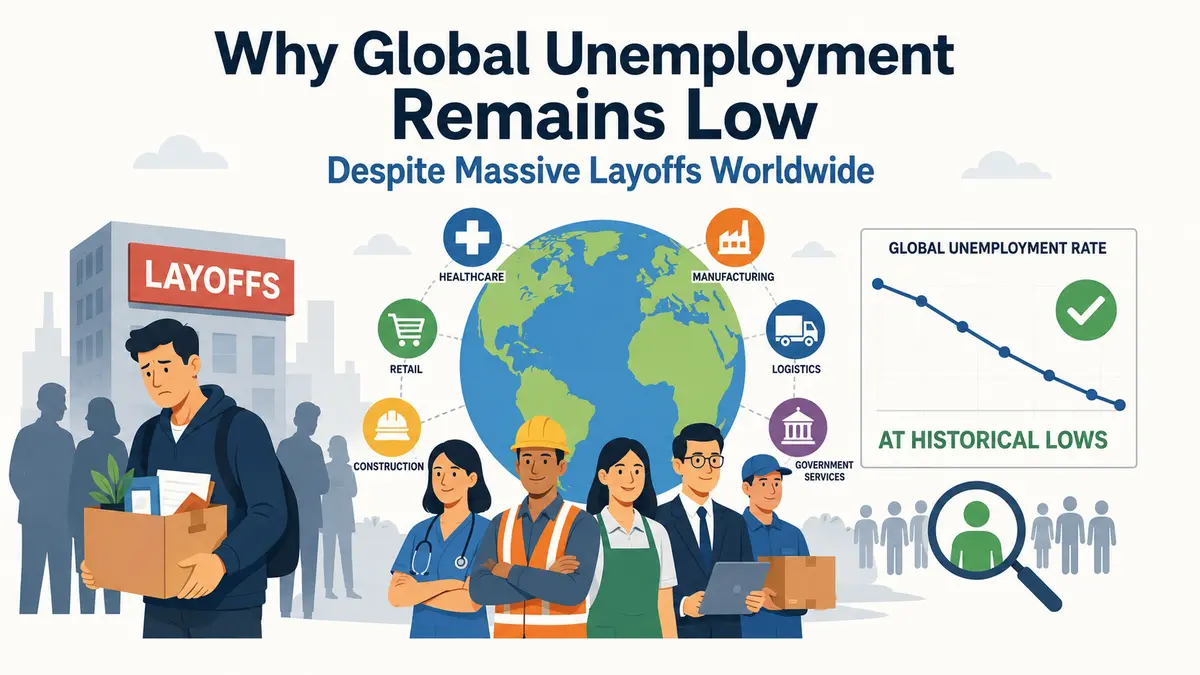
Over the past few years, headlines about massive layoffs at companies like Amazon, Meta, and Alphabet have been all over the internet. Thousands of people getting fired, tech workers posting “Open to Work” on LinkedIn, and everyone wondering whether the job market is about to explode. But here’s the weird part: global unemployment is actually near historical lows and has been falling over time. Wait a fucking minute. If companies are throwing thousands of people out the door, shouldn’t unemployment be going up? Well, the global labor market doesn’t work quite that simply.
Below is the global unemployment rate data from the World Bank.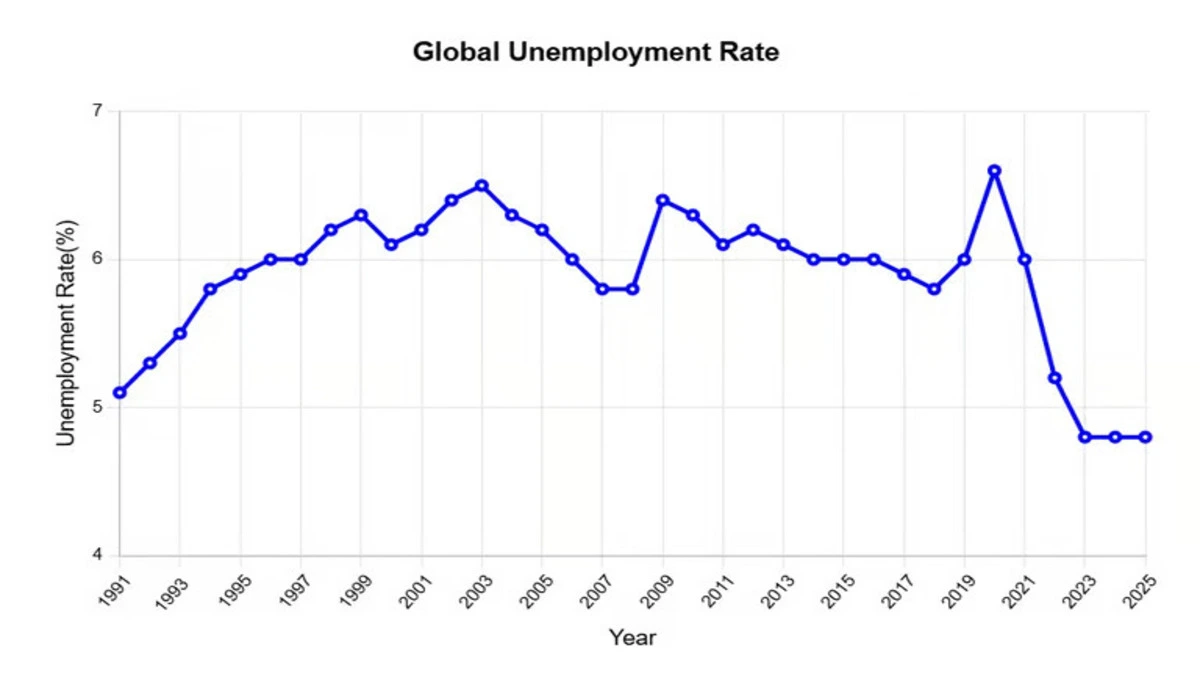
Most of the layoffs people hear about come from big tech companies. These companies have traditionally been seen as the promised land of employment: high salaries, great benefits, fancy offices, and enough free snacks to make you question whether you actually need a kitchen at home. But after years of aggressive hiring and increasing AI-driven automation, the sector isn’t growing at the same pace it once did. Graduates who specialized in these fields are now facing tougher competition because there are more people chasing these jobs while companies are becoming more selective about who they hire.
Here’s another thing people often miss: tech is a tiny part of the global labor market. It gets enormous attention because the companies are massive, the salaries are high, and every layoff becomes headline news. Basically, if Amazon fires 10,000 people, the internet loses its fucking mind. If 10,000 people get hired in some other industry nobody has heard of, absolutely nobody cares.
Outside of tech, millions of jobs continue to be created across healthcare, retail, logistics, construction, hospitality, manufacturing, and government services. So while one part of the economy is cutting jobs, another part can be hiring at the same time. Another major reason for the layoffs is pandemic-era over-hiring. Many companies hired aggressively when demand was booming and are now correcting their staffing levels.
There’s also another problem: unemployment statistics don’t tell us everything about the labor market. Someone can technically be classified as employed while working part-time, freelancing, running a small business, doing gig work, or earning very little. The unemployment rate also doesn’t capture underemployment, unstable income, poor job quality, or people who have stopped looking for work. So technically, you can be employed, miserable, underpaid, and wondering what the fuck happened to your career, and the unemployment statistics will still happily count you as employed.
Currently, gig work and freelancing are growing, while traditional forms of self-employment, such as small shops, farming, local trades, and informal businesses, are changing. At the same time, the economy is slowly shifting away from some traditional blue-collar and routine office jobs toward more skill-based, service-oriented, and technology-driven roles. This also means job quality is becoming more uneven. Some workers have more flexibility than ever, while others are stuck with unstable gig work, unpredictable income, or multiple jobs just to keep things going.
Overall, the labor market isn’t simply shrinking or expanding in one direction. It’s constantly changing. Some jobs disappear, others are created, and entire industries change the kind of workers they need. The shift toward flexible, skill-based, service-oriented, and technology-driven work is changing the structure of employment even when the headline unemployment rate barely moves.
So the next time you see a headline saying “10,000 people laid off!”, don’t immediately assume the entire job market is collapsing. Ten thousand people losing their jobs is obviously a big deal for those ten thousand people. But the global labor market has billions of workers doing millions of different things. One company can be firing people while the economy as a whole is still hiring. That’s the weird part about economics.