
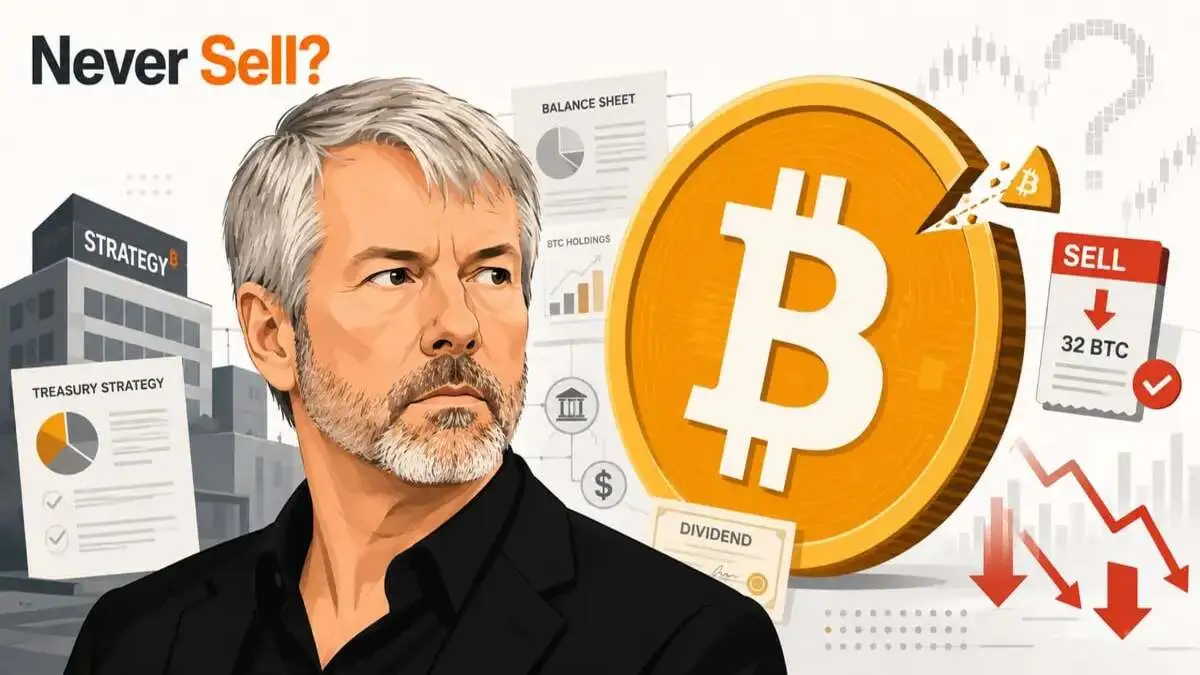
Imagine the loudest voice in the room telling everyone to hold on tight, no matter what happens, because giving up is never an option. Now imagine that same voice quietly stepping back, even just a little. That’s roughly what happened when Michael Saylor’s company sold 32 Bitcoin in late May 2026.
It wasn’t a huge amount. In fact, it barely moved the needle compared to what his company holds. But the reaction online was loud, fast, and full of “wait, didn’t you say never?” type comments. For someone who spent years telling people to hold Bitcoin no matter what, even one sale felt like a crack in the armor.
So what actually happened here? Is this a sign that Bitcoin’s biggest cheerleader is losing faith? Or is this just business as usual, blown out of proportion by people who weren’t paying close attention? Let’s break it all down, starting with who this guy actually is.
Who Is Michael Saylor
Before Bitcoin made him famous in crypto circles, Michael Saylor was already a well known name in the tech world. He co-founded MicroStrategy back in 1989, and for most of its early life, the company had nothing to do with cryptocurrency at all. It was a business intelligence software company, the kind of company that helps other businesses analyze data and make smarter decisions.
For decades, that’s all MicroStrategy was known for. Steady, unremarkable, software-focused.
Then 2020 happened. With interest rates near zero and inflation worries building up, Saylor started looking at his company’s cash reserves and didn’t like what he saw. Holding cash in a low interest rate environment meant that money was slowly losing value. So instead of sitting on it, he decided to do something most CEOs at the time thought was completely insane.
In August 2020, MicroStrategy bought 250 million dollars worth of Bitcoin for its corporate treasury. At the time, this was seen as a bold, even reckless move. But for Saylor, it was just the beginning. After that first purchase, he didn’t just quietly hold the position. He went all in on promoting Bitcoin, and he never really stopped.
How Deep His Bitcoin Belief Went
Once Saylor made that first Bitcoin purchase, something shifted. He started describing Bitcoin as a shield against inflation, a way to protect his company’s money from losing value over time. That message alone made headlines, because no major public company had said anything like that before.
But he didn’t stop at one purchase. Over the following years, Saylor’s company kept buying more Bitcoin, and the methods got increasingly aggressive. He issued corporate debt to raise cash for Bitcoin purchases. He sold company shares to raise even more cash for Bitcoin purchases. Slowly, something interesting started happening to how investors viewed his company.
People stopped thinking of MicroStrategy as a software business. Instead, they started treating it as a leveraged way to bet on Bitcoin’s price. If Bitcoin went up, the stock went up even more. If Bitcoin went down, the stock dropped harder. The software side of the business basically became background noise.
At some point, Saylor leaned fully into this new identity. He renamed the company to simply “Strategy” and positioned it as the world’s first and largest Bitcoin treasury company. No more pretending this was a software business with a side hobby. Bitcoin was now the main show.
And the numbers back this up in a big way. Strategy currently holds around 4 percent of all the Bitcoin that will ever exist. To put that in perspective, even massive institutional players like BlackRock’s Bitcoin ETF hold only about 3.64 percent. The entire United States government holds somewhere between 0.94 and 1.56 percent.
That makes Saylor’s company the largest known holder of Bitcoin in the world, second only to Bitcoin’s mysterious creator, Satoshi Nakamoto. That’s an incredible amount of influence concentrated in one company’s hands, built almost entirely on one man’s conviction.
His Famous Bitcoin Views
If you’ve spent any time around crypto Twitter or YouTube, you’ve probably come across at least one Saylor quote, even if you didn’t know it was him.
“HODL” became something close to a personal motto for him, even though the term existed in crypto culture before he adopted it. He took it and turned it into a full philosophy. According to Saylor, Bitcoin was going to the moon, supply was strictly limited, and the price could hit a million dollars within five years.
He didn’t stop at price predictions either. He made statements that were almost shocking in how extreme they sounded. At one point, he suggested people should sell almost anything, even joking about selling a kidney, before ever selling their Bitcoin. He went as far as saying that if Bitcoin ever dropped to zero, he would buy more, not less.
Perhaps his boldest line was aimed directly at skeptics. He told people that if they wanted to bet against Bitcoin, they should short his company’s stock instead, because his company would never sell its Bitcoin holdings.
These weren’t quiet, careful statements made in boardrooms. These were loud, public, repeated declarations made across interviews, conferences, and social media. For years, this messaging worked. It built him a massive following and turned him into one of the most recognizable faces in Bitcoin advocacy.
Which is exactly why what happened next caused such a stir.
32 BTC Sale
In late May 2026, Strategy sold 32 BTC, worth roughly 2.5 million dollars, between May 26 and May 31. This was the company’s first Bitcoin sale since December 2022, when they sold a larger amount for tax purposes.
Here’s the thing. 32 BTC is an incredibly small number compared to Strategy’s total holdings of over 843,000 BTC. We’re talking about roughly 0.0038 percent of their total stash. In any normal context, this would barely register as news.
But context matters, and so does irony. The man who told people to short his stock instead of selling Bitcoin, the man who said he’d buy more if Bitcoin hit zero, the man behind “never sell,” was now part of a company that just sold Bitcoin. People on social media wasted no time pointing this out, and the criticism was sharp.
Saylor’s response came at a Bitcoin event in Prague. He pushed back on the idea that this was some kind of betrayal. His main argument was a distinction between personal advice and corporate decision making. According to him, when he said “never sell your Bitcoin,” he was talking to individuals about their personal holdings, not making a promise about how his publicly traded company would manage its treasury.
He pointed out that Strategy’s potential to sell Bitcoin had actually been disclosed in earnings calls and regulatory filings for years. The sale itself was tied to funding dividend payments on Strategy’s preferred stock, a financial product the company uses to raise money. He framed the decision through the lens of “Bitcoin per share,” arguing that selling a small amount now could help the company buy back more later, ultimately increasing the Bitcoin held per share over time.
He also made a pointed comment defending the move, essentially saying he wasn’t going to destroy a massive company just to avoid selling a tiny fraction of its Bitcoin.
Whether you find that explanation reasonable or a bit too convenient probably depends on how closely you followed his original messaging. But one thing is clear: the gap between “we will never sell” and “well, technically I meant individuals” is a gap a lot of people noticed.
What This Means for Bitcoin’s Future
Here’s the part that’s hard to ignore. This is a man who built his entire public image around one idea: never sell, no matter what. He told people to short his stock instead of betting against Bitcoin. He said he’d buy more even if the price hit zero. And now, his own company has sold Bitcoin for the first time in years.
So the real question isn’t whether 32 BTC matters in dollar terms. It’s why someone this deep into Bitcoin, someone whose entire identity and net worth are tied to it, would make this move at all. Is this just normal corporate housekeeping, like he claims? Or is it an early sign that even the most committed believer is starting to feel pressure he didn’t expect?
Right now, the honest answer is we don’t know for sure. The amount sold is too small to draw a firm conclusion either way. But small moves like this often matter less for what they are and more for what they hint at. If a company with this much riding on Bitcoin’s success is willing to sell even a little, it raises the question of what happens if things get tighter. Is this the first small step of a much bigger shift, or just noise that won’t matter a year from now?
Only time will tell. But one thing is for sure, the gap between what Saylor preached for years and what his company just did is now part of the story, whether he likes it or not.