Imagine you’re sitting at a poker table. You’ve been playing for hours, reading the room, making calculated bets. But there’s one player at the table who can see everyone’s cards. He doesn’t cheat loudly, he’s subtle about it. He just always seems to fold at the right time and bet big when it matters. And when the game is over and you’ve lost money, he smiles and says, “Sorry, I just got lucky.”
That’s the stock market. And that player? He’s called an insider.
Now here’s the uncomfortable part: this isn’t illegal in the way most people think. In fact, the system is specifically designed to let him play this way. And the rules that are supposed to stop him? He helped write them.
What Is Inside Information and Why Should You Care?
Let’s keep this simple.
Inside information is any piece of news about a company or the economy that isn’t publicly known yet but would significantly move the price of a stock if it were. Think of things like a company secretly planning to acquire a competitor, a government about to announce a massive infrastructure contract, or a central bank preparing to cut interest rates.
The moment that information becomes public, markets react. Prices move. Sometimes dramatically.
The person who knows it before everyone else has a massive advantage. They can buy before the price shoots up. Or sell before it crashes. Either way, they profit and you, the ordinary investor who found out from the news like everyone else, are left holding the bag.
This isn’t about being smarter or working harder. It’s purely about knowing something that others don’t. And that’s the problem.
Who Actually Has This Advantage?
When people hear “insider trading,” they usually picture a shady executive whispering stock tips at a golf club. And yes, that happens. But the reality is much broader and far more systemic.
Company Executives and Founders
The people running a company know everything about its upcoming earnings, a deal that’s about to fall through, a product launch being delayed, a lawsuit that’s about to be settled. They live inside the company. By definition, they know things shareholders don’t.
Politicians and Lawmakers
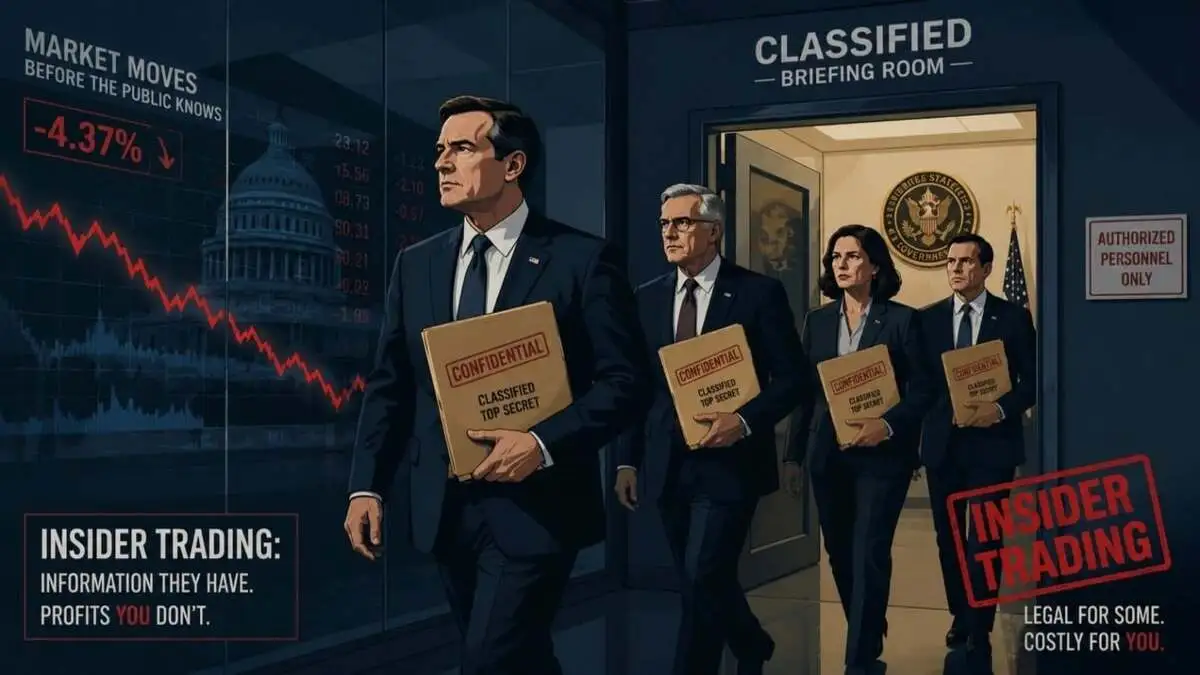
This one doesn’t get enough attention. Politicians sit on committees that regulate entire industries. They receive classified briefings about economic crises, geopolitical events, and policy changes before any of it is announced publicly. A senator who sits on the banking committee and knows a major regulatory change is coming before it’s announced has an information edge that no hedge fund can compete with.
Central Bank Officials
These are perhaps the most powerful insiders of all. The people who set interest rates know their decisions before markets do. An interest rate decision doesn’t just move one stock it moves entire asset classes. Bonds, equities, currencies, real estate all of it shifts the moment a rate decision is announced. The people making that decision have days or weeks of advance notice that the rest of the world doesn’t.
Regulators Themselves
The people responsible for investigating insider trading sometimes have access to market-moving information through their own work. It’s a layer of irony that most people don’t think about.
The higher up you go in business or government, the bigger the information advantage. And right now, the system does very little to neutralize it.
So What Does the Current System Actually Do?
Every major financial market in the world has some version of insider trading rules. The US has the SEC. The EU has the Market Abuse Regulation. The UK has the FCA. Most countries have their own version of the same basic framework.
And they all essentially work the same way.
You trade. Then you disclose.
In the US, insiders must report their trades within two business days of executing them. In the EU, it’s three business days. The details vary slightly by country, but the core structure is identical everywhere the trade happens first, and the public finds out after.
Think about what that means in practice.
A company executive decides to sell a large chunk of his stock because he believes the company is heading into trouble. He executes the trade on Monday. The public finds out on Wednesday. By Thursday, the stock starts falling as the market processes the news. Retail investors who held through this period took the full hit. The executive got out clean at Monday’s price.
And this is the legal version of events.
The Enforcement Problem
Even this limited post-trade disclosure system is riddled with failures.
In the US, Congress passed the STOCK Act in 2012 specifically to stop lawmakers from trading on inside information. The penalty for violating it for failing to disclose a trade on time is a $200 fine. For people making millions of dollars on their trades, $200 isn’t a deterrent. It’s barely an inconvenience.
In 2020, several US Senators sold large amounts of stock just before the COVID-19 pandemic caused a massive market crash. They had attended a private government briefing about the severity of the outbreak. The Department of Justice investigated. Nobody was charged. All investigations were quietly closed.
This is not an anomaly. It’s a pattern. The system consistently fails to hold powerful people accountable not because investigators aren’t trying, but because the rules themselves make prosecution extraordinarily difficult. To prove insider trading under the current framework, you have to prove not just that someone traded but that they traded because of specific non-public information. That’s an almost impossible standard to meet in court.
Why the Current System Is Fundamentally Broken
The post-trade disclosure system has a core philosophical problem that no amount of regulatory tinkering can fix.
It protects the insider. Not the investor.
The entire logic of disclosing after the trade is complete is that the insider’s transaction is already done. They’ve already locked in their price. The public finding out two days later changes nothing for the insider but it changes everything for the retail investor who was on the other side of that trade without knowing what the insider knew.
Regulators defend this system with a few standard arguments. Let’s be honest about each of them.
“Pre-announcing trades would cause market panic.” But the panic happens anyway two days later, when the disclosure comes out. All post-trade disclosure does is delay the panic by 48 hours so the insider can exit at a better price. That’s not protecting the market. That’s protecting the insider at the market’s expense.
“It could be misused if other traders would front-run the insider.” The current system already allows insiders to front-run everyone else. An executive who sells because he believes his company’s stock will drop 30% is capturing that information advantage entirely for himself. The ordinary investor absorbs the full loss. This argument essentially says, “Let’s protect the insider’s ability to front-run the market.”
“It would deter legitimate trading for personal financial needs.” This is the only argument with even partial merit and it completely dissolves the moment you realize that an insider can simply state their reason when they pre-disclose. “Selling 2% of my stake for tax obligations” is a very different market signal than “selling 2% of my stake for unknown reasons.” Transparency doesn’t prevent trading. It just forces honesty about the reasons.
The uncomfortable truth is that the current system wasn’t carefully designed with investor fairness in mind. It evolved through decades of lobbying by the very people who benefit from keeping the information edge intact.
The Fix Is Actually Simple
Here it is in one sentence:
If you know more than everyone else, you must say so before you act, not after.
Any insider executive, politician, central banker, regulator who wants to trade must publicly disclose their intent before the trade happens. Not after. Not simultaneously. Before.
With a mandatory waiting period say 24 to 48 hours before the trade can actually execute.
That’s it. That’s the entire idea.
And here’s why it works so elegantly. The moment an insider discloses their intent to trade, their information advantage evaporates. If a central bank official announces they’re buying bonds tomorrow, the market immediately asks why and prices adjust accordingly. The inside information effectively becomes public information the moment the trade is pre-announced. The edge disappears before a single share changes hands.
The insider can still trade. Their right to manage their finances isn’t taken away. They just have to be honest about it first.
“But Won’t This Cause Problems?” Let’s Address the Obvious Pushbacks
Won’t insiders just fake announcements to move markets and then cancel?
This is a real concern and it has a real solution. Once a trade is pre-announced, it becomes an irrevocable commitment. The insider must execute within the disclosed trading window. Cancellation without a legitimate documented reason triggers severe penalties. The announcement becomes a binding commitment, not a tool. This is actually stronger than anything currently on the books anywhere in the world.
Won’t capital flee to markets with looser rules?
Two things happen simultaneously here. Yes, some short-term speculative capital that profits from information asymmetry will leave. But at the same time, the market becomes dramatically more attractive to long-term institutional investors, pension funds, sovereign wealth funds, endowments who currently avoid certain markets precisely because of governance concerns. The capital that leaves is the kind that extracts value from ordinary investors. The capital that enters is the kind that creates long-term economic value. The composition of investment improves even if the total volume takes time to recover.
What about large transactions destroying liquidity?
Large insider transactions think a founder selling a 5% stake can already be handled through block deals. These are pre-negotiated transactions with institutional buyers at a fixed price range, executed cleanly without hitting the open market and causing a panic. Block deals already exist in most major markets. Under a pre-disclosure system they simply become the standard mechanism for large insider transactions. The liquidity problem essentially solves itself.
Won’t the sheer volume of disclosures create information overload?
Not really. The number of disclosures doesn’t change; insiders already disclose every trade today, just after the fact. Moving the disclosure to before the trade doesn’t increase the volume of information. It just shifts it earlier in time. Same amount of information. Just more useful.
The Bigger Picture What Happens If One Country Actually Does This?
Here’s where it gets interesting.
The standard objection to any country implementing stricter financial regulation is competitive disadvantage. “If we tighten the rules and nobody else does, capital will go somewhere with looser rules.”
But this argument ignores something important about regulatory gravity.
When the EU introduced the General Data Protection Regulation (GDPR) in 2018, every major tech company threatened to leave or restructure. The doomsday predictions were everywhere. What actually happened? GDPR became the de facto global data privacy standard. The US, Brazil, Japan, India and dozens of other countries moved toward GDPR-style frameworks not because they were forced to, but because companies operating globally found it easier to adopt one high standard than to maintain different systems for different markets.
The same logic applies here. If a large enough economy implements mandatory pre-trade disclosure and becomes visibly more attractive to quality long-term capital as a result, other countries face competitive pressure to follow. Not immediately. Not without resistance. But the direction of travel is clear.
The markets that resist will increasingly be seen as places where the rules favor insiders over ordinary investors which is exactly the reputation that drives quality institutional capital away over time.
So Why Hasn’t This Happened?
This is the most important question. And the honest answer is uncomfortable.
The people who would need to pass this reform are insiders themselves.
Lawmakers who trade stocks would need to vote to pre-announce their own trades. Executives who sit on regulatory advisory boards would need to advocate for rules that eliminate their own information edge. Central bank officials who currently operate with complete privacy around their personal finances would need to accept public scrutiny of every investment decision.
There’s also a political timing problem that has nothing to do with bad intentions. The short-term pain of implementing some capital outflow, market adjustment, increased volatility during the transition happens immediately and visibly. The long-term benefits of fairer markets, better quality investment, stronger public trust in financial systems accumulate gradually and are credited to no one in particular.
Politicians are not incentivized to absorb visible short-term pain for diffuse long-term gains that someone else will take credit for. This is a structural problem with how democratic systems process long-horizon reforms and it applies to this issue as much as it applies to climate policy or pension reform.
None of this means the idea is wrong. It means the idea is right but politically difficult. Those are very different things.
The Bottom Line
The current global system of insider trading regulation is not a carefully designed framework for investor protection. It is a compromise that has been shaped, over decades, by the people who benefit most from keeping the information edge intact.
The fix is not complicated. It does not require new technology, new institutions, or revolutionary thinking. It requires one simple shift in principle:
Disclose before you act. Not after.
If you have information that others don’t because you run the company, because you sit on a committee that regulates an industry, because you set the interest rates that move entire economies you should have to tell the world what you’re doing with your money before you do it.
Not to punish you. Not to restrict your freedom. Just to give everyone else the same chance you already have.
The game doesn’t have to be rigged. But right now, it is and the people with the power to change it are the same people winning because of it.
That’s the problem. And unlike most problems in finance, the solution is actually simple.
We just have to want it badly enough to demand it.