
Most retail options traders aren’t sitting at home calculating implied volatility curves, hedging their portfolios, and doing mathematical gymnastics before placing a trade. They’re speculating on the market. In other words, they’re basically gambling.
They often try to predict a future event, whether it is a company beating its earnings, a candidate winning an election, or a specific economic report, and they want to bet on it without realizing that insiders are locked and loaded, ready to fuck them.
Anyway, for those traders, the traditional options market is a minefield of hidden costs, mathematical traps, and a lot of other unnecessary complications. They mostly don’t care about “the Greeks” (Delta, Vega, Gamma, and Theta). They are more focused on the end result rather than pricing the option contract.
This is why prediction markets are rapidly growing as a superior vehicle for retail speculators. By stripping away the complexities of option contracts, prediction markets offer a direct, transparent, and cost-efficient way to bet on outcomes. Below are some reasons why speculators should consider switching.
1. Simplicity
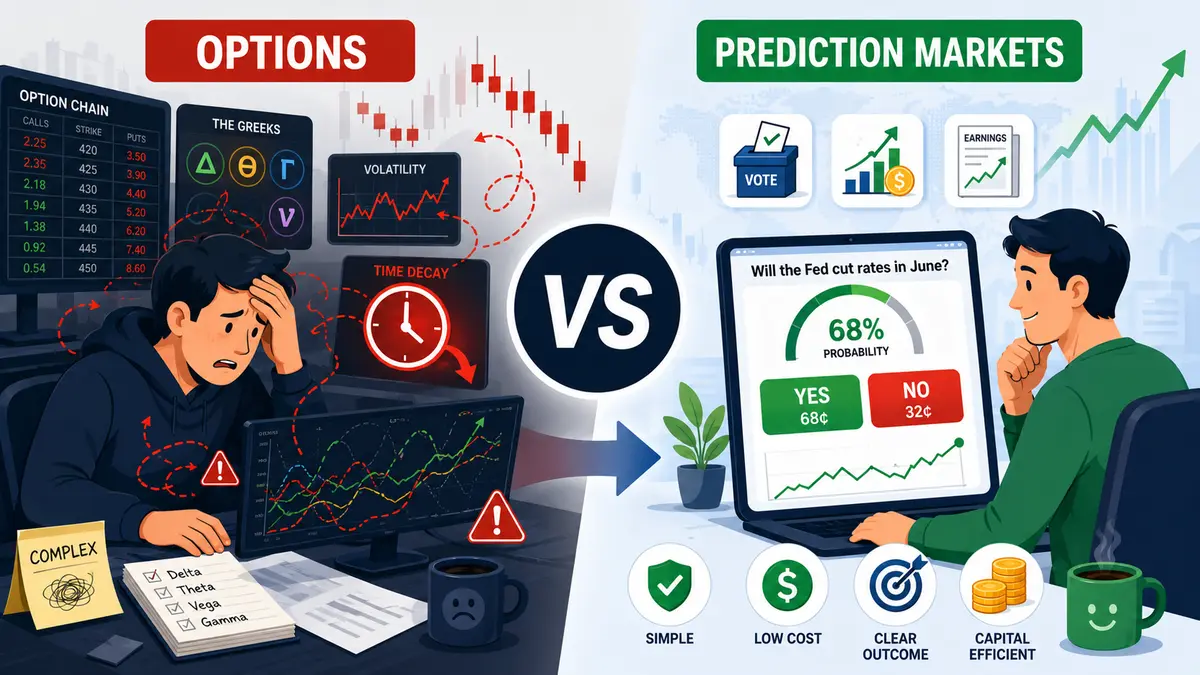
One of the biggest barriers to entering into options trading is the complexity of pricing. Options are simply not just about predicting the direction but more about pricing the option using “greeks” such as time decay (theta), volatility (vega), and the speed of price movement (gamma).
The Retail Reality: Most retail speculators buy or sell an option contract because they think the price will move their direction. They often get crushed by the markets not because they were wrong about the direction but because the market stayed flat for two weeks (time decay) or volatility dropped.
The Prediction Market Solution: Prediction markets operate on a simple “Yes” or “No” basis. If you believe an event will happen, you buy “Yes.” If it happens, you get a fixed payout (usually a dollar). If it doesn’t, you lose your money. There are no complex formulas to memorize. The price of the contract is the market’s probability of the event occurring.
For a speculator, this clarity is important. You are not fighting a time-decay clock; you are simply betting on the overall crowd’s probability assessment.
2. “Time Decay” Trap
A recent study shows that the vast majority of retail option traders lose money primarily due to time decay and sentiment-driven overpaying.
The Options Trap: Studies show that retail traders lose billions of dollars to market makers because they buy options based on directional sentiment rather than option fundamentals. The value of an option erodes every single day as it approaches expiration, meaning you need the market to move fast and in the right direction just to break even.
The Prediction Market Advantage: While prediction markets do have settlement dates, the pricing mechanism is much more linear. You won’t be fighting a non-linear decay curve. The market price simply moves in a direction as new information comes by. If you are right about the outcome, you win, regardless of how slowly the news broke, assuming you held until resolution.
3. Lower Costs and Better Capital Efficiency
Costs eat into profits, and options trading is way more expensive for smaller accounts.
Spread and Commission Costs: Brokers may charge commissions, while bid-ask spreads can also add to your trading costs. These spreads can be particularly wide for out-of-the-money contracts, which means you may already be at a disadvantage when entering the trade.
The Prediction Market Edge: Many prediction platforms use pari-mutuel systems or automated market makers (AMMs) to facilitate trading. Depending on the platform, these systems can provide relatively tight spreads, greater transparency, and comparatively low fees.
Furthermore, because contracts often trade between $0 and $1, you can take a position with a small amount such as $10 or $100. In options, a single contract usually contains 100 shares, requiring significantly large capital to enter a comparable position.
4. Taxation
Taxation plays a big role here. For retail speculators, the taxation in prediction markets is more favorable than that of standard securities.
Favorable Rates (US): In the US, regulated event contracts are often taxed as futures contracts. This allows the 60/40 rule: 60% of gains are taxed at the lower long-term capital gains rate, and 40% at the short-term rate, regardless of how long you held the position. This is better than the standard short-term income tax rate applied to most stock and option trading profits.
Gambling Exemptions (Global): In some countries, prediction-market winnings may be tax-free for individuals. The UK is one example where certain gambling winnings are generally not subject to income or capital gains tax. Options trading, however, can be treated differently and may be subject to capital gains tax depending on the circumstances.
Simpler Reporting: Some decentralized prediction markets operate on blockchain networks, which can give crypto traders a transparent record of their transactions. Options trading can involve more complicated tax reporting, particularly when calculating cost basis and gains across multiple trades.
Note: Tax laws are different from country to country and can change over time. Always check the rules that apply to you, especially because some countries may classify prediction markets as gambling or treat them as unlicensed financial activity.
Final Verdict: A Better Tool for the Speculator
If your goal is simply to speculate on whether a particular outcome will happen, traditional options may not be the simplest tool. You have to deal with Greeks, time decay, volatility, expiration dates, and the capital required to take the position.
Prediction markets take a much more straightforward approach. You choose an outcome, decide how much you want to risk, and take a position on whether that outcome will happen.
The main advantages are pretty straightforward:
- Simplicity: You are essentially making a Yes-or-No prediction rather than pricing an option.
- Clarity: Your potential profit and maximum loss are generally clear before you enter the trade.
- Capital efficiency: You can often take relatively small positions without needing the capital required for a standard options contract.
- Potential tax advantages: Depending on where you live and how the market is classified, the tax treatment may be more favorable.
For the retail trader who just wants to make a bet on what happens next, prediction markets cut through all the options bullshit and let you do what you came here for: make a prediction and pray to God you’re right.
Disclaimer: This content is for informational purposes only and does not constitute financial, tax, or legal advice. Prediction markets and options trading can make your portfolio cry if you don’t know what you’re doing. Do your own research, check the rules in your country, and remember, I am just here explaining shit, not managing your money. Please don’t sue me. I am not responsible for your investment decisions.