
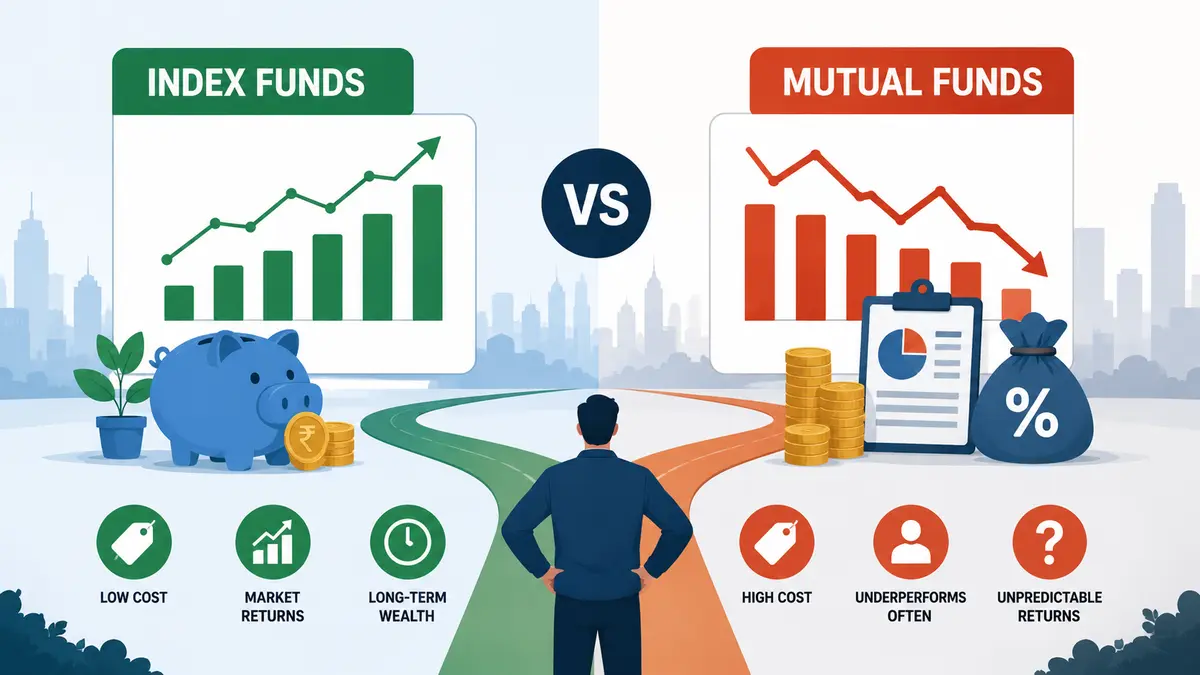
Say, after spending lavishly in your 20s, you are in your 30s and decide, “Let’s not fuck around. Let’s save and invest my money so that I can retire.” You don’t have much knowledge about investing, so you ask a guy who knows a guy who knows a guy, and they send you to a stockbroker. The stockbroker looks promising, giving you a lot of technical information that you are not familiar with, so at the end, you are convinced of his skills. Then he suggests that you invest in a particular actively managed mutual fund instead of an index fund.
Let me tell you one thing first: this guy, whether he is an expert or not, doesn’t give a damn whether you make money or not. He may be more interested in the commission or fees he is going to get from you investing in that mutual fund.
I did not mean all mutual funds are bad, but many actively managed funds tend to be a pain in the ass over longer time periods. A typical actively managed mutual fund might give you better returns compared to an average bank deposit. But in most cases, its returns are typically lower than those of an index fund. Why settle for less when you have something that tends to be even better?
First, let’s see what a mutual fund is. Say you are a rich dude who wants his own fund manager to manage your finances. Hiring a personal fund manager is expensive, but you can afford it. But that is not the case for poor dudes like me, hence the existence of mutual funds. An actively managed mutual fund has a fund manager or investment team who manages a portfolio, but instead of managing one guy’s money, they manage the money of a lot of broke dudes. The bigger the fund size, the more money the company can potentially make from management fees.
We judge everyone, right? The same way, we can judge a fund manager by using a metric called a benchmark, which is essentially an index they are trying to compete with. An index tracks a group of companies based on a particular market, sector, or category. For example, the S&P 500 index tracks 500 major companies in the US. We can directly invest in these indices by investing in index funds.
Actively managed funds generally try to beat the returns provided by their benchmark. Most fund managers might beat the benchmark for a year or two, but over the long run, say 5, 10, or 20 years, most of them fail to do so. You might think, why couldn’t these nerdy fund managers beat a simple index? It is not because they turned into retards or something, but because active management has some structural disadvantages that make consistent outperformance difficult. Let’s see the problems here.
The first thing you might expect is the fees they charge. Your stockbroker can upsell you by saying they charge just 0.50% per year. But in reality, he is making 0.5% sound like nothing when that small percentage can end up as a massive sum after 20 years. Compounding really is a bitch that people tend not to overlook.
Fund size matters. Say you have a house worth $100k. It is easy to sell, right, since a lot of people have that kind of money. But now say you have a $10 million house. It is difficult to find a buyer since rich dudes are quite rare. The same thing applies here. Buying an index fund with $1000 has no impact on the market, but a fund manager buying millions of dollars’ worth of a small or illiquid stock can move its price, hence affecting the overall returns.
One thing that people need to know about advertising is that, say, there is a new fund. No one would have heard about it since it is new, so the amount the fund is managing is also less. So, they might have made quite a lot of returns since it is easy to manage. Once they make good returns, it’s their looting time. Companies market it, claiming, “We made these extraordinary returns. Buy it. This is the next gold rush or whatever”. Then a lot of goofballs rush into the fund and get horribly massacred. Just know that if there is a good fund, it is either probably not heard of or it’s too late. Because more people get into it, the bigger the size of the fund and the harder it is to manage.
Managing a large fund itself is hard. Combined with fees, it gets even harder unless the fund manager is an extra-smart, galactic, ultra-nerd who can tell the future, which is rare. Over longer periods, low-cost index funds have historically tended to outperform the majority of comparable actively managed funds after fees and costs. But anyway, if you are planning to invest over the long run, it is better to consider an index fund instead of an actively managed fund.
Disclaimer: This article is for educational purposes only and is not financial advice. Don’t you dare lose money and sue my ass. I am not responsible for your investment decisions. Do your own research or hire a qualified financial professional. Don’t blame me.